Qualitative research poster examples: themes, quotes and context
Quick answer
How do you present qualitative research on a poster?
Make the title the main insight, then show the themes as a diagram or a row of boxes, each with one short quote attributed by pseudonym or role. Describe the method in a few lines: who took part, how many, how they were recruited, how the data were collected and how they were analysed (for example reflexive thematic analysis). Add a sentence on your position as researcher and the main limitation, and report against COREQ or SRQR. Avoid percentages of participants; say "most" or "a few" instead.
Qualitative posters have a different job from quantitative ones: instead of one effect size, they have to convey what people said and what it means, in words that can be read from a metre away. The strongest ones give the themes a visual structure and let a few carefully chosen quotes do the work.
The examples below are an interview study with first-generation university students (social science, APA 7) and an oral history project on a closed port, with a map and a timeline (humanities). Download either as an editable PowerPoint file, or open it in the editor and replace the content with your own study.
Note: The authors, institutions, participants and quotes on these posters are illustrative, made up to show what a finished poster looks like; they are not real studies or real people. Maps marked "Simulated" show fictional places. The references are real: each one was checked and links to the published work.
Open the Social Science template · All research poster examples
Qualitative research poster examples
-
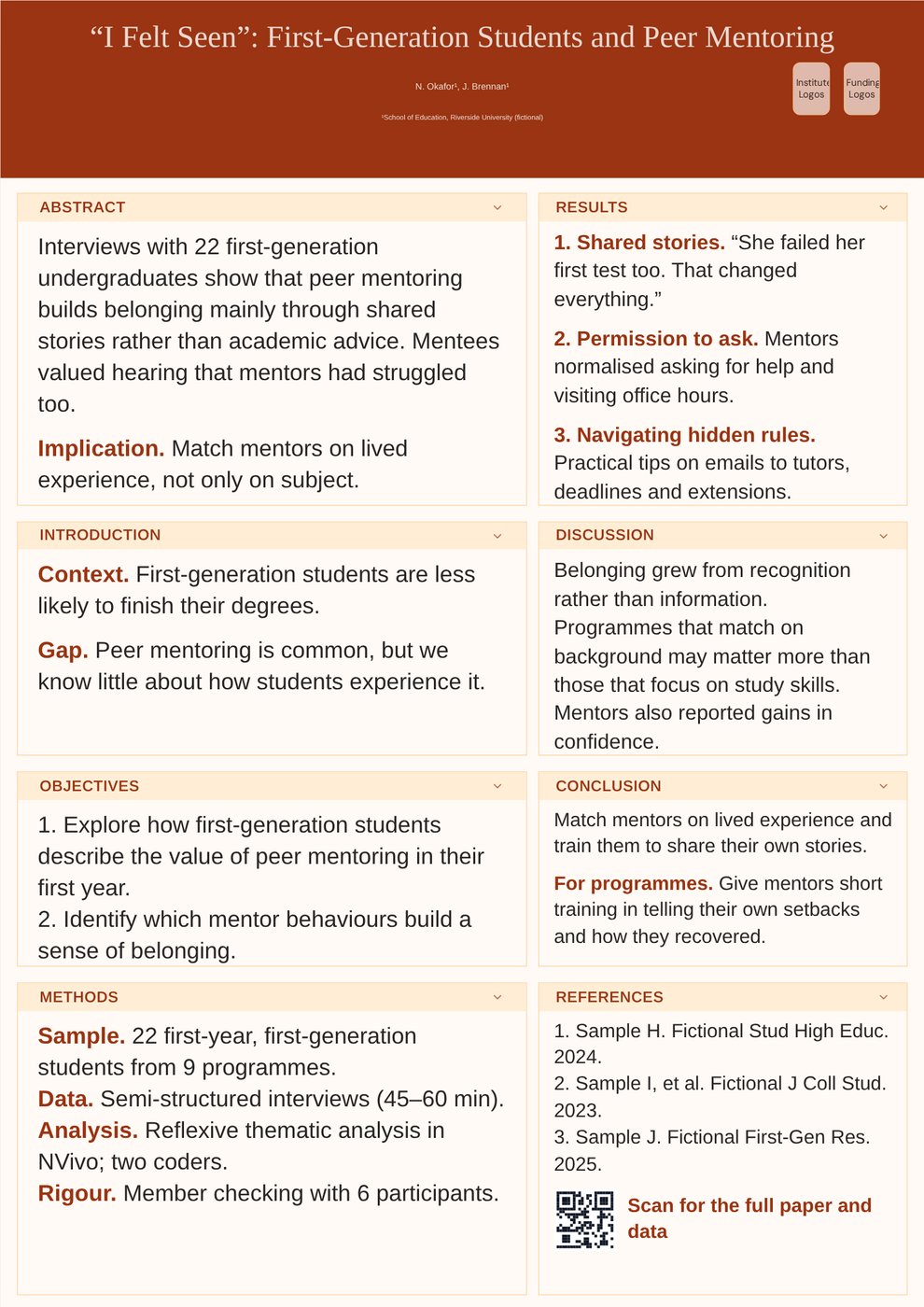
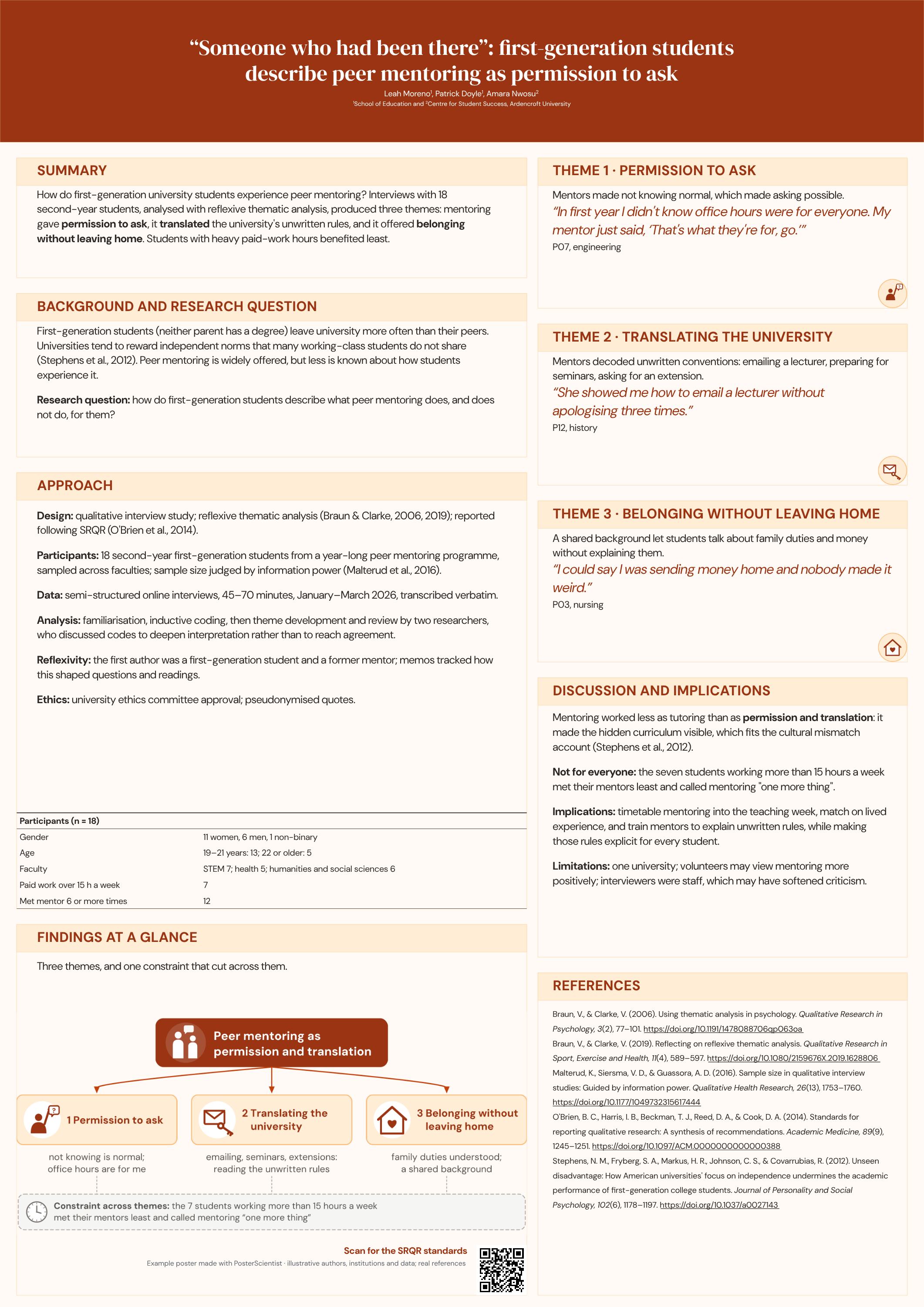
“Someone who had been there”: first-generation students describe peer mentoring as permission to ask
Social science · qualitative interview study · Template: Social Science (Free) · A0 portrait (841 × 1189 mm) · Follows: SRQR: approach, sampling, reflexivity, analysis, themes with participant quotes
Why it works
Qualitative results are presented as three named themes, each with one short quote attributed by participant number and discipline, plus a thematic map whose icons reappear in each theme box. The methods name the approach (reflexive thematic analysis), the sampling logic and the researchers' position, and a negative case is reported rather than smoothed away.
References on the poster (APA 7 style)
- Braun, V., & Clarke, V. (2006). Using thematic analysis in psychology. Qualitative Research in Psychology, 3(2), 77–101. https://doi.org/10.1191/1478088706qp063oa
- Braun, V., & Clarke, V. (2019). Reflecting on reflexive thematic analysis. Qualitative Research in Sport, Exercise and Health, 11(4), 589–597. https://doi.org/10.1080/2159676X.2019.1628806
- Malterud, K., Siersma, V. D., & Guassora, A. D. (2016). Sample size in qualitative interview studies: Guided by information power. Qualitative Health Research, 26(13), 1753–1760. https://doi.org/10.1177/1049732315617444
- O'Brien, B. C., Harris, I. B., Beckman, T. J., Reed, D. A., & Cook, D. A. (2014). Standards for reporting qualitative research: A synthesis of recommendations. Academic Medicine, 89(9), 1245–1251. https://doi.org/10.1097/ACM.0000000000000388
- Stephens, N. M., Fryberg, S. A., Markus, H. R., Johnson, C. S., & Covarrubias, R. (2012). Unseen disadvantage: How American universities' focus on independence undermines the academic performance of first-generation college students. Journal of Personality and Social Psychology, 102(6), 1178–1197. https://doi.org/10.1037/a0027143
Download PowerPoint · Open in editor · Use this template
-
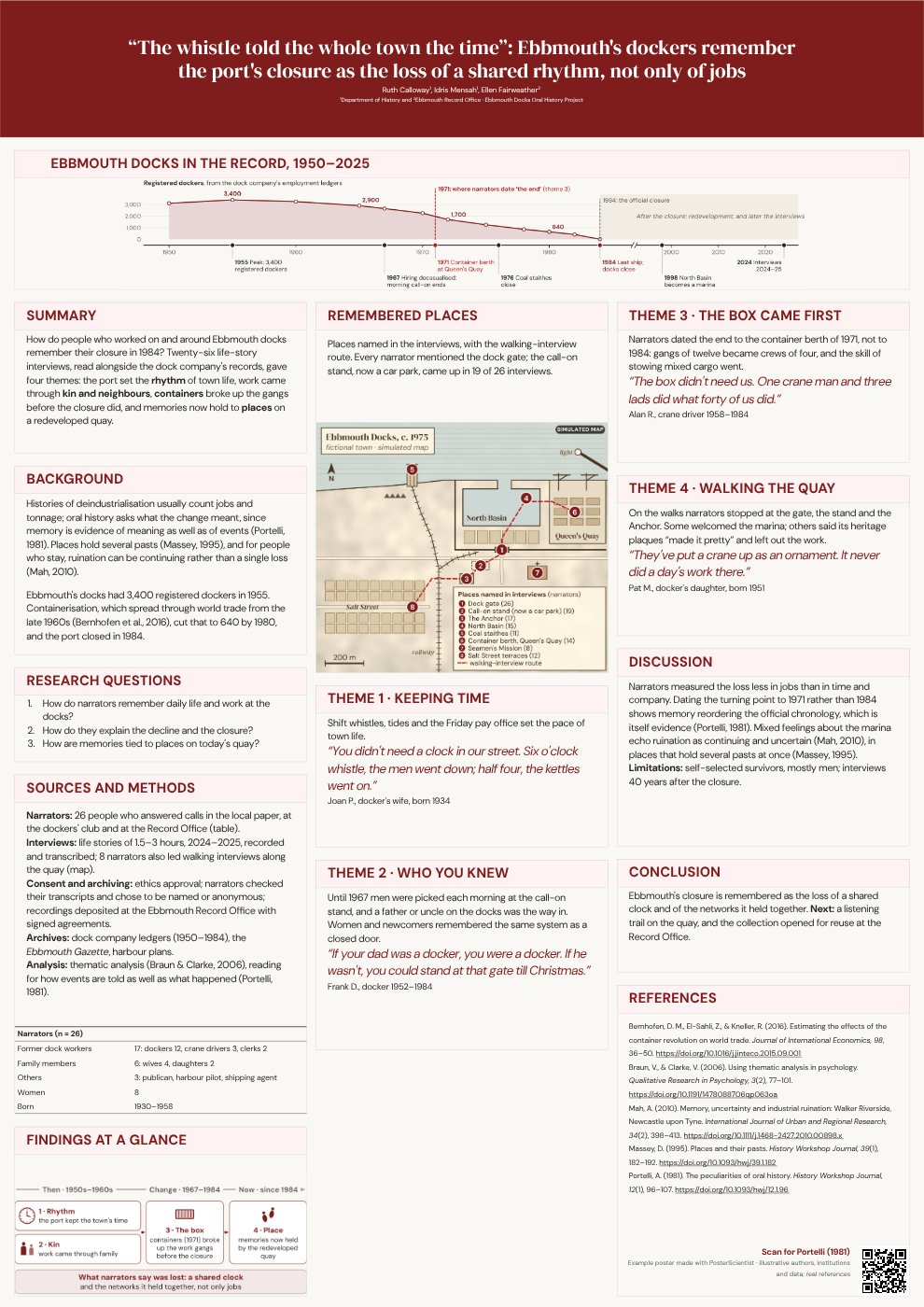
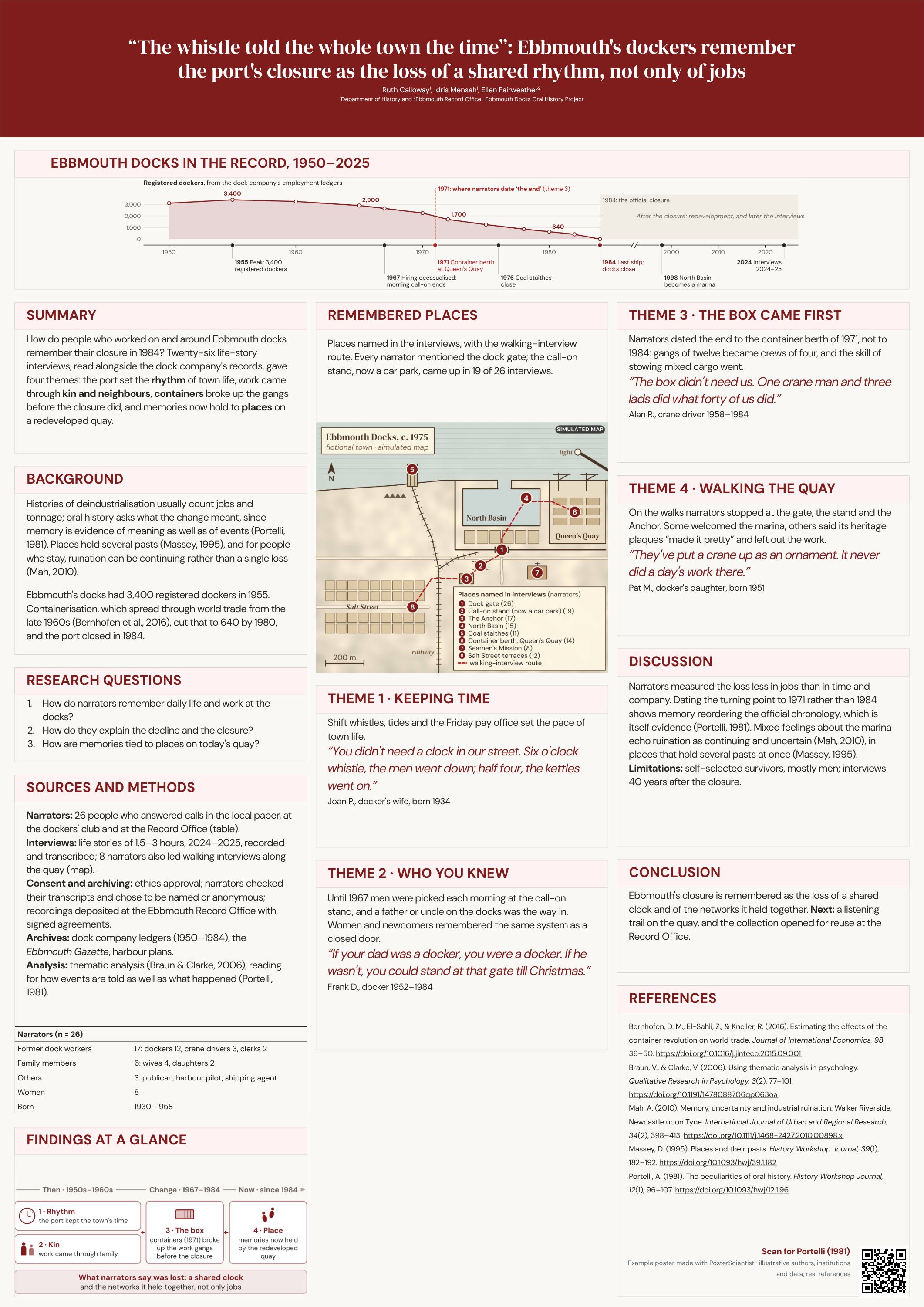
“The whistle told the whole town the time”: dockers remember the port's closure as the loss of a shared rhythm, not only of jobs
Humanities · oral history project · Template: Elegant Serif (Free) · A0 portrait (841 × 1189 mm) · Follows: Oral history: narrators and how they were found, consent and archiving, themes with attributed quotes, read alongside the archive
Why it works
A timeline across the top sets the archive's numbers (registered dockers, the container berth, the closure) beside the dates narrators actually used, so the poster can show where memory and the record disagree. Each theme gets its own box with one short, attributed quote, consent and archiving are stated, and a theme diagram links the themes in time. The port and its people are fictional: the map of the docks is a simulated, historical-style map with the walking-interview route, labelled as simulated.
References on the poster (APA 7 style)
- Bernhofen, D. M., El-Sahli, Z., & Kneller, R. (2016). Estimating the effects of the container revolution on world trade. Journal of International Economics, 98, 36–50. https://doi.org/10.1016/j.jinteco.2015.09.001
- Braun, V., & Clarke, V. (2006). Using thematic analysis in psychology. Qualitative Research in Psychology, 3(2), 77–101. https://doi.org/10.1191/1478088706qp063oa
- Mah, A. (2010). Memory, uncertainty and industrial ruination: Walker Riverside, Newcastle upon Tyne. International Journal of Urban and Regional Research, 34(2), 398–413. https://doi.org/10.1111/j.1468-2427.2010.00898.x
- Massey, D. (1995). Places and their pasts. History Workshop Journal, 39(1), 182–192. https://doi.org/10.1093/hwj/39.1.182
- Portelli, A. (1981). The peculiarities of oral history. History Workshop Journal, 12(1), 96–107. https://doi.org/10.1093/hwj/12.1.96
Download PowerPoint · Open in editor · Use this template
Showing themes
- Give each theme a short, active name ("Permission to ask") rather than a topic label ("Help-seeking").
- Lay the themes out so their relationship is visible: a row for parallel themes, an arrow for a process, a ring around a central idea.
- Put one quote and one or two sentences of interpretation in each theme box; move the rest to a handout or the QR-linked paper.
- Use the same icon or colour for a theme everywhere it appears, so readers can follow it across the poster.
Choosing and attributing quotes
- Pick quotes that are short (under 30 words), concrete and typical of the theme, not just the most colourful line.
- Attribute each quote with a pseudonym or role and a relevant detail ("Priya, second year, nursing"), never a real name.
- Set quotes larger than the body text or in italics, so the participants' words stand out from your interpretation.
Methods and rigour in a few lines
Readers want to know who took part and how you analysed what they said. A small table of participants (by group, not individually identifiable), one line each on recruitment, data collection and analysis, and a sentence on reflexivity are usually enough. Name the reporting guideline you followed: COREQ for interview and focus group studies, or SRQR for qualitative research more broadly.
Maps, timelines and context
Humanities and historical projects often need the reader to see where and when things happened. The oral history example uses a simple map with numbered places that match the narrators' accounts and a timeline that sets the narrators' memories against the documentary record. Keep both clean: few labels, a scale bar and a north arrow on the map, and only the dates the argument needs on the timeline.
Frequently asked questions
Should a qualitative poster include numbers?
Include the sample size and participant characteristics, but avoid reporting themes as percentages of participants. Words such as "most", "several" or "a few" are more honest for small, purposive samples.
How many quotes should a qualitative poster have?
About one per theme, plus perhaps one in the title area. Four to six short quotes are usually enough; more makes the poster hard to read from a distance.
Which template suits a qualitative or humanities poster?
A layout with large boxes and room for quotes works best. These examples use the Social Science template (A0 portrait) and the Elegant Serif template, which suits humanities and historical work.
Are these real studies?
No. The participants, quotes and places are illustrative, made up to show a finished poster. The references are real and were checked.