Psychology poster templates with APA-style reporting
Quick answer
How do you format a psychology research poster?
Use APA-style structure and statistics: a title that states the finding, an introduction ending in clear hypotheses, a method section with participants (N, age, gender, recruitment), design, measures and procedure, and results given as test statistic, degrees of freedom, exact p value, effect size and confidence interval. Finish with a short discussion and APA-format references, and let one or two figures carry the results.
Psychology posters are judged on clear hypotheses and honest statistics. Visitors will look for your N, your design and whether you reported effect sizes, so these should be visible within seconds, not buried in a paragraph.
Start from the free Psychology Study template, or the Social Science layout for qualitative and survey work. Both download as editable PowerPoint files, ready for the APA conventions below.
Open the Psychology Study template · See a social science example
Free PowerPoint downloads
- Psychology Study, A0 portrait (.pptx)
- Psychology Study, 48 × 36 in landscape (.pptx)
- Psychology Study, 36 × 48 in portrait (.pptx)
- Social Science, A0 portrait (.pptx)
Editable .pptx with the slide set to the real poster size. One click, no sign-in.
Templates for psychology posters
-
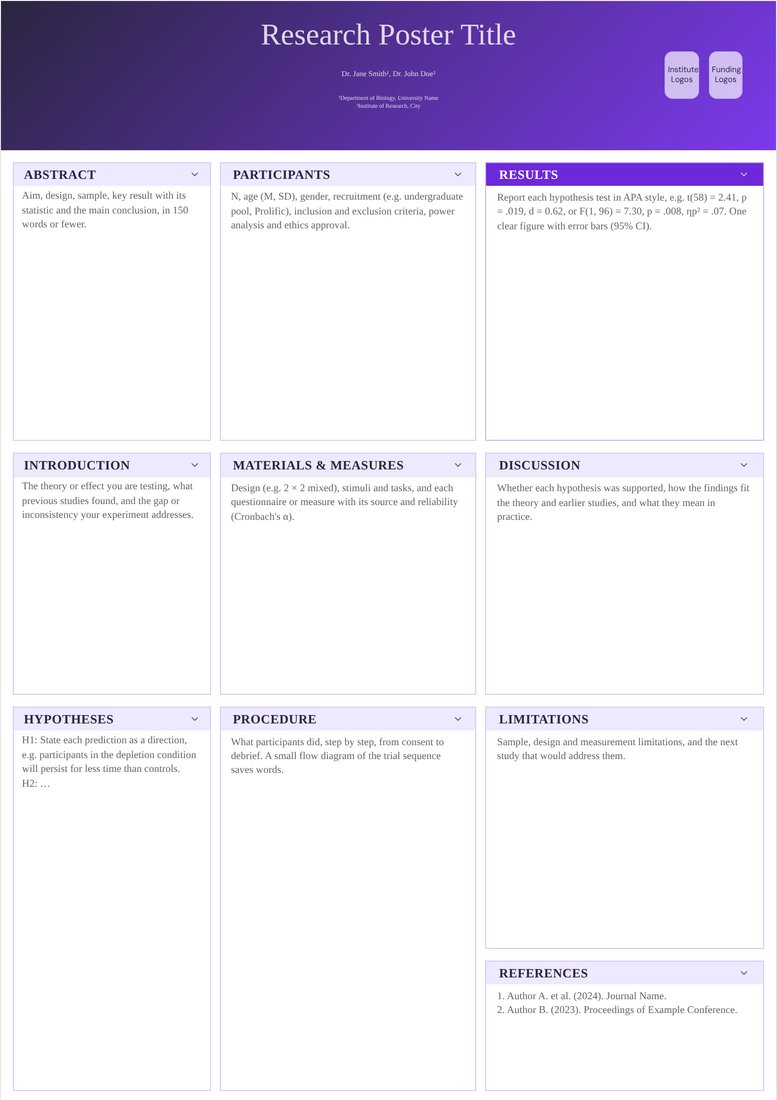
Psychology Study (Free)
Free. APA order in three columns: introduction and numbered hypotheses, then participants, materials and procedure, then results, discussion and limitations in the widest column.
-
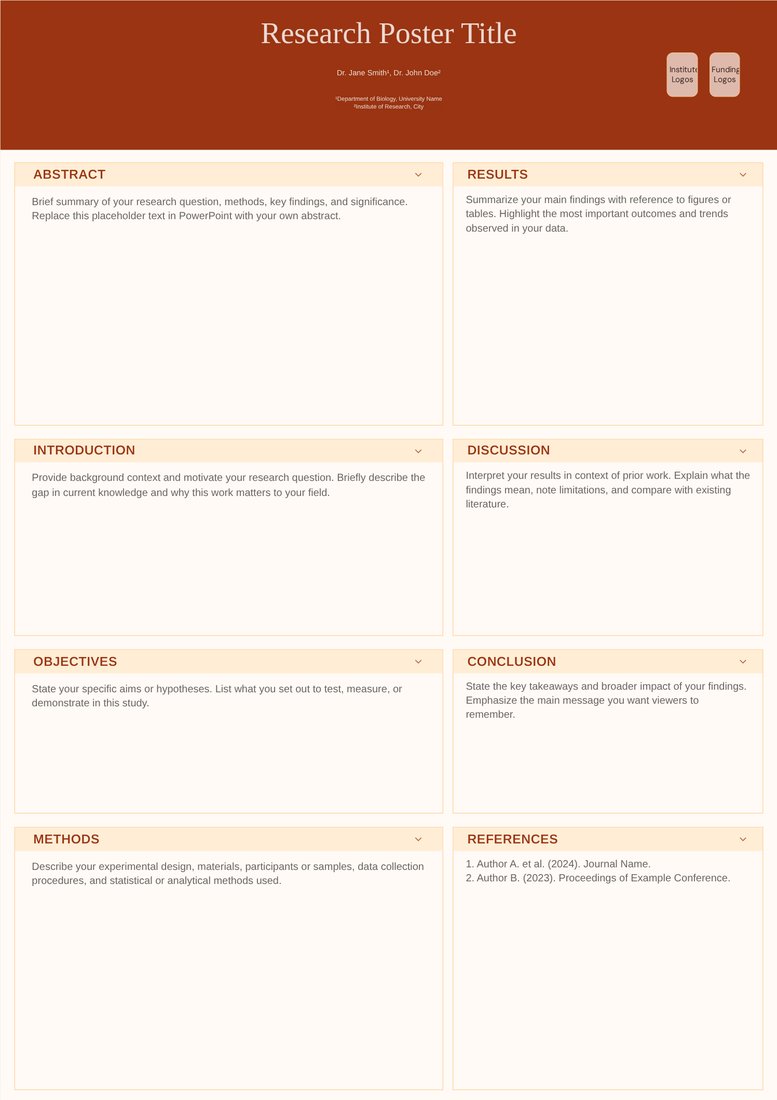
Social Science (Free)
Free. A wide context-and-method column beside a narrower findings column, in terracotta with serif headings; good for interviews, surveys and mixed methods.
-
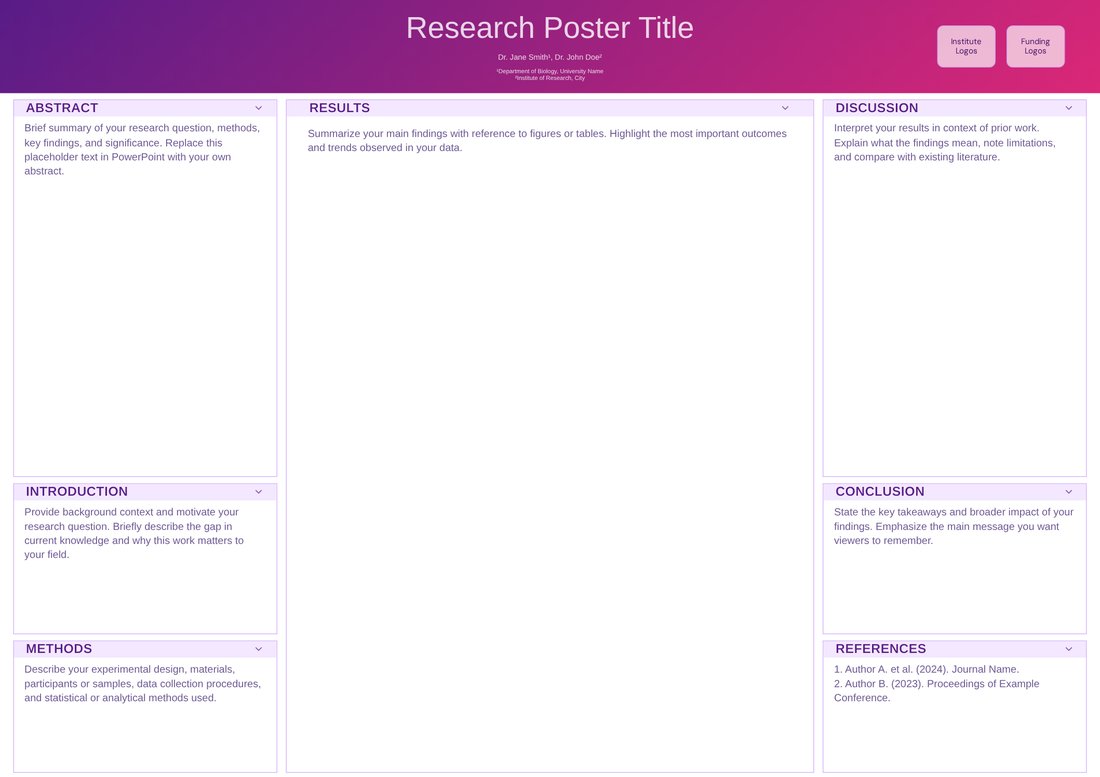
Neuroscience Wide (Free)
Free. A0 landscape with a double-width centre column for brain maps, EEG traces or other cognitive neuroscience figures.
-
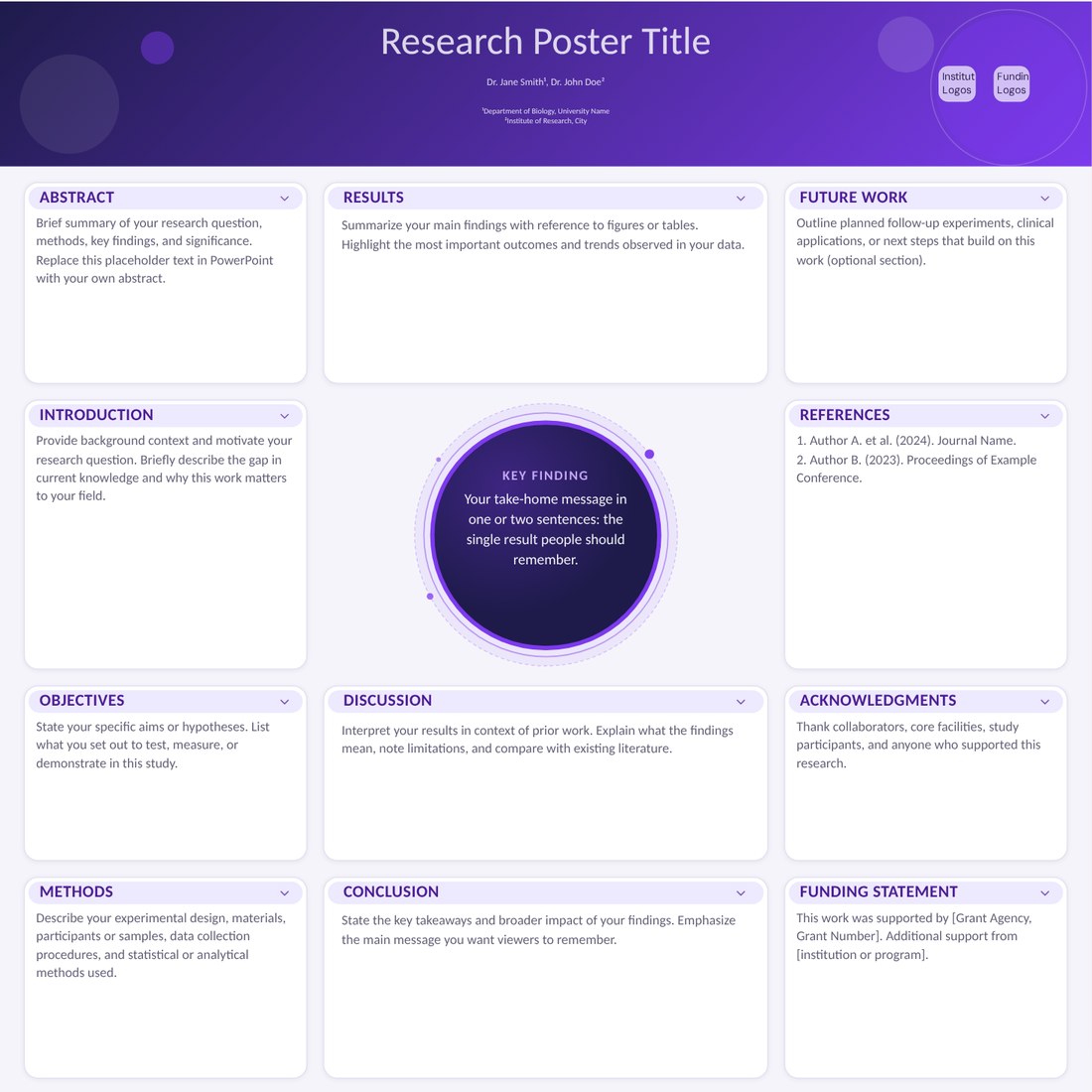
Orbit (Pro)
Pro. One central finding in a circle with rounded cards around it, for a single clear experimental effect.
APA style on a poster
- Report statistics in APA format, for example t(58) = 2.41, p = .019, d = 0.62, 95% CI [0.10, 1.14], with statistical symbols (M, SD, t, F, p, r) in italics.
- Give exact p values to two or three decimals and write p < .001 for very small values; drop the leading zero for values that cannot exceed 1, such as p and r.
- Report means and standard deviations for each condition, ideally on the figure rather than in a separate table.
- Keep references in APA format (7th edition) and in small type; four to six are enough on a poster.
- Posters do not need manuscript formatting such as running heads or double spacing.
Hypotheses, method and participants
End the introduction with numbered hypotheses and refer back to them in the results ("H1 was supported"). In the method, give participants in one line, for example: N = 124 undergraduates (71% women; M age = 20.3 years, SD = 2.1) recruited through a participant pool. Then state the design (for example a 2 × 2 mixed design), the key measures with their reliability, and the procedure as a short flow diagram.
If the study was preregistered, say so and link the preregistration with a QR code. Open data and materials can be linked the same way.
Figures for psychological data
- Show distributions, not just bars: dot plots, violin plots or raincloud plots make individual differences visible.
- Define error bars in the caption (SE, SD or 95% CI).
- For interactions, a line plot with conditions on the x axis and groups as labelled lines reads faster than a table.
- Use plain-language axis labels ("Recall accuracy (%)") rather than variable names ("ACC_T2").
Qualitative and survey posters
For interviews and focus groups, present findings as named themes with one short participant quote each, and state the analytic approach (for example reflexive thematic analysis) and the number of participants. For surveys, give the response rate, the scales used and their reliability, such as Cronbach's alpha.
What psychology conferences usually ask for
Psychology conferences typically accept posters through a short abstract and assign each one a board and a session time. Board sizes and orientation differ between meetings, so check the presenter instructions before choosing a template. Departmental and student poster days often follow APA style for text and references and judge posters on the clarity of the hypotheses, the fit of the analysis and the presentation of results. Mention ethics approval or exemption in one line under the method.
Class and undergraduate posters
- Check the course rubric for required sections; many follow the order of an APA manuscript.
- If results are not significant, report them the same way and discuss power; a clear null result is a valid poster.
- Practise a one-minute explanation of the design and the main result.
Frequently asked questions
Does a psychology poster have to follow APA style?
Most psychology conferences and courses expect APA-style statistics and references, but posters do not need manuscript formatting such as running heads or double spacing. Follow your conference or course instructions.
How do I report statistics on a psychology poster?
Give the test statistic with degrees of freedom, the exact p value, an effect size and its confidence interval, for example t(58) = 2.41, p = .019, d = 0.62, 95% CI [0.10, 1.14].
What goes in the method section of a psychology poster?
Participants (N, age, gender, recruitment), design, measures with reliability and the procedure, ideally as a short flow diagram. Keep it to a few labelled lines.
Which template should I use for a qualitative psychology study?
Social Science. Its wide left column holds context and method, and the findings column suits named themes with short participant quotes.
What size should a psychology poster be?
Use the size in the presenter instructions. 48 × 36 in landscape is common in North America and A0 portrait in Europe; every template opens at either size.