Biology poster templates for lab, imaging and field research
Quick answer
What is the format of a biology research poster?
Most biology posters follow IMRAD: an Introduction ending in a hypothesis, Methods (organism or cell line, design, sample sizes and statistical tests), Results as two to four figures with takeaway headings, and a Discussion with conclusions, plus references, acknowledgements and funding. Figures need scale bars, defined error bars and n for each panel, and species and gene names follow standard italic conventions.
In biology the figure is the argument. Visitors scan blots, micrographs, growth curves and maps, and only read the text when a figure makes them curious, so a biology poster should be built around its figures rather than around paragraphs of background.
Classic Academic suits most bench biology, Neuroscience Wide gives imaging a double-width column, and Field Ecology is made for fieldwork. All three are free PowerPoint downloads; Midnight Aurora is a Pro option for data-rich biomedical work.
Open Classic Academic · Scientific poster templates for STEM
Free PowerPoint downloads
- Classic Academic, A0 portrait (.pptx)
- Classic Academic, 36 × 48 in portrait (.pptx)
- Classic Academic, 48 × 36 in landscape (.pptx)
- Neuroscience Wide, A0 landscape (.pptx)
Editable .pptx with the slide set to the real poster size. One click, no sign-in.
Templates for biology posters
-
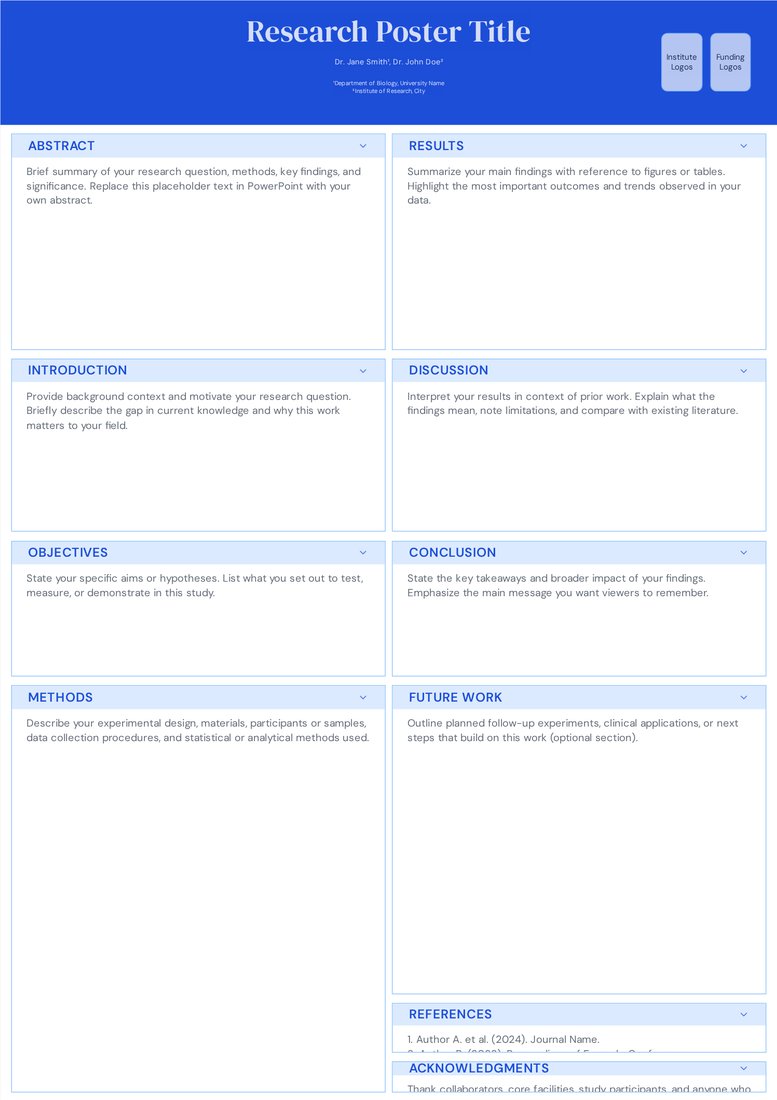
Classic Academic (Free)
Free. Two wide columns for full-width gel images, microscopy panels and growth curves; switch to three columns for many small panels.
-
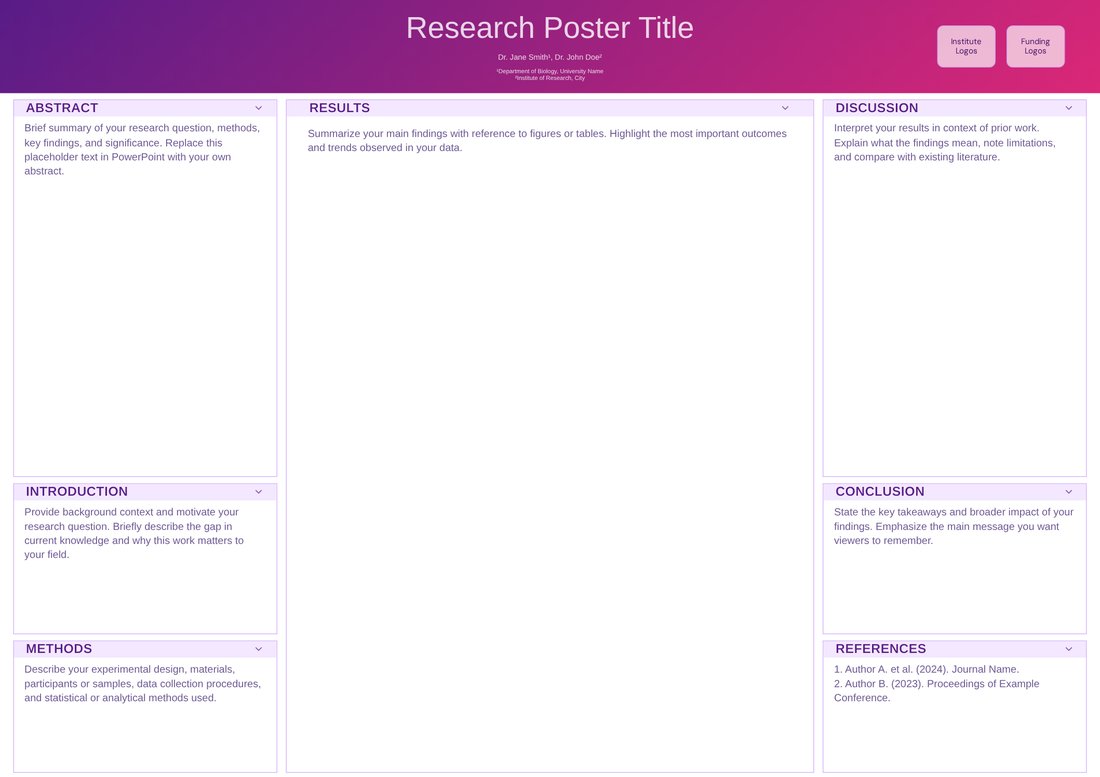
Neuroscience Wide (Free)
Free. A0 landscape with a centre column twice the width of the others, for large imaging or multi-panel figures.
-
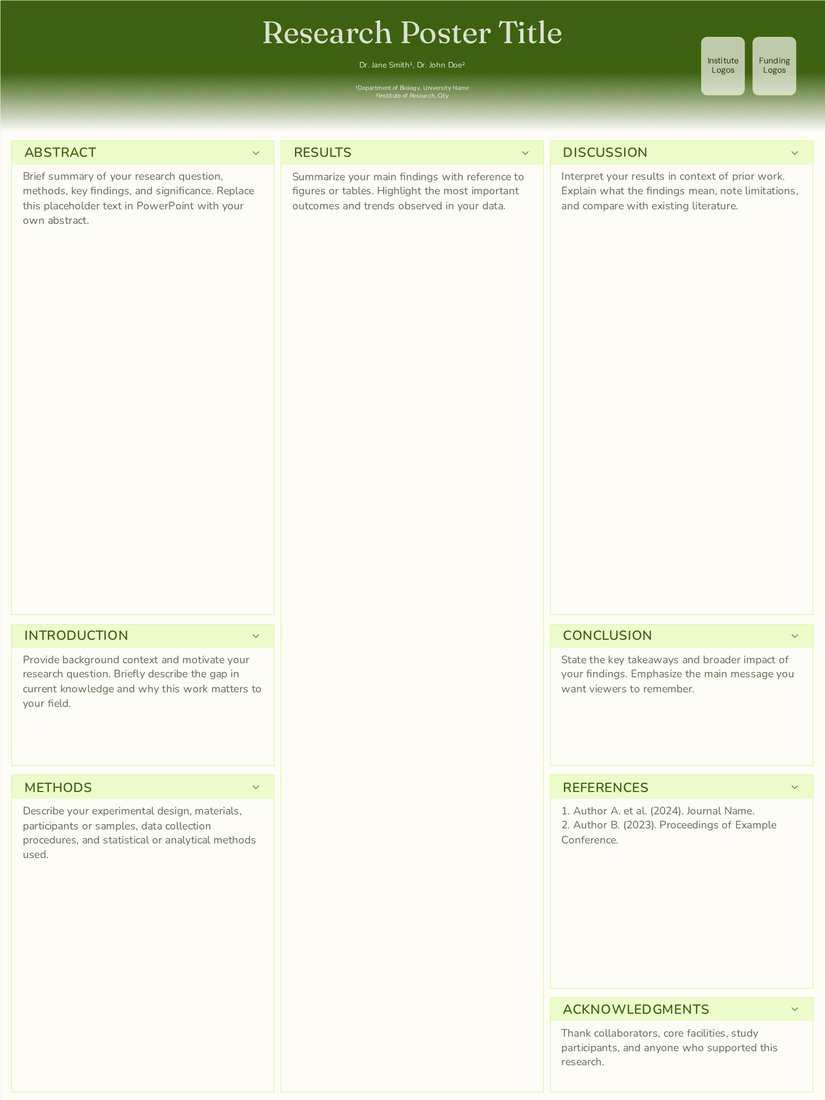
Field Ecology (Free)
Free. Three columns with a full-height centre for a study-site map and results, in olive and sand tones.
-
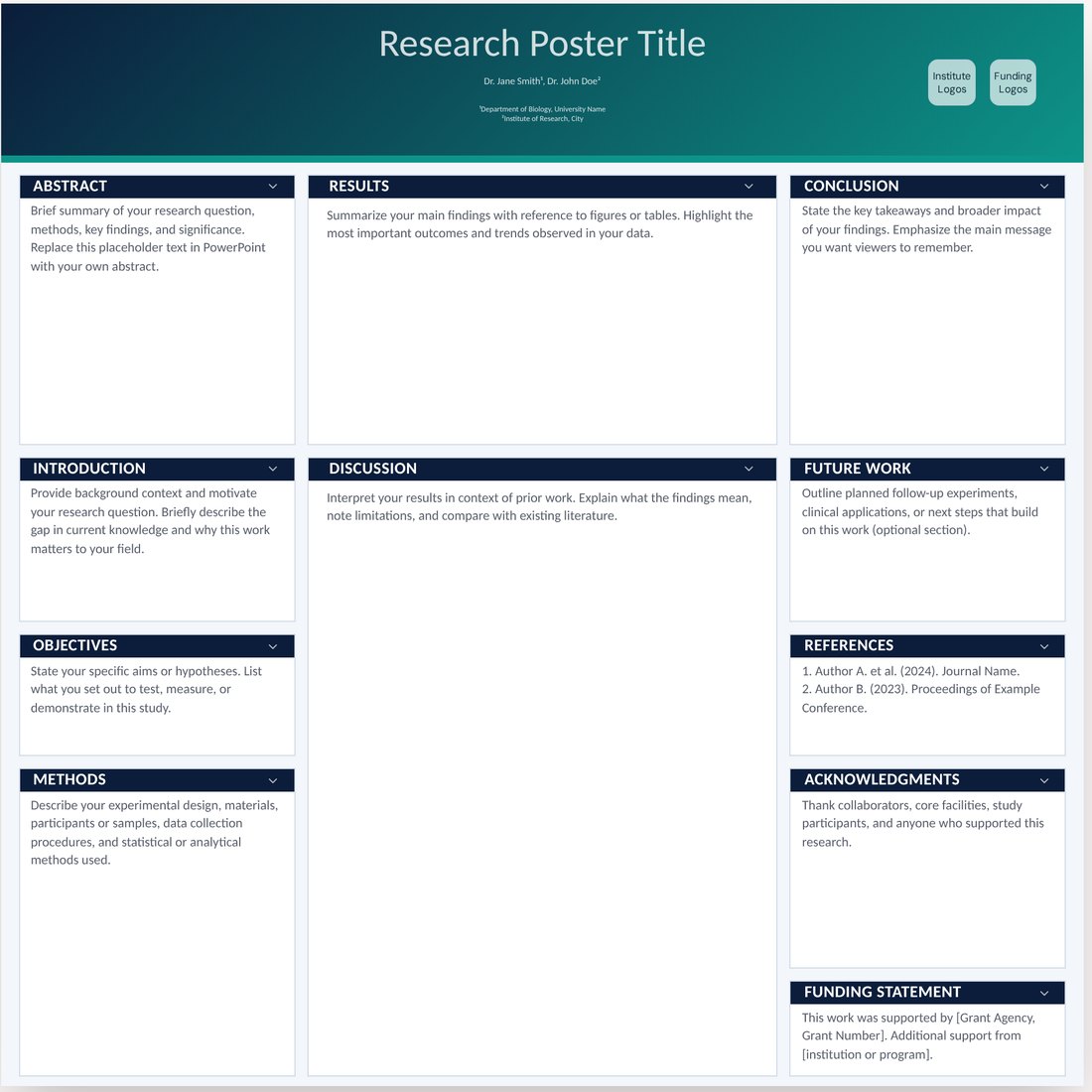
Midnight Aurora (Pro)
Pro. A wide central results column for several linked figures, such as a screen, its validation and a mechanism diagram.
IMRAD, cut down to poster size
- Introduction: two to four sentences ending in a hypothesis or question, ideally with a small diagram of the system or pathway.
- Methods: organism, strain or cell line, key treatments, sample sizes, replicates and statistical tests. A workflow diagram beats prose.
- Results: one figure per finding, each headed with its conclusion ("Knockdown of gene X halves cell migration").
- Discussion: what the results mean, a model figure if you have one, limitations and the next experiments.
- Back matter: five to ten references, acknowledgements, funding and a QR code to the preprint or data.
Naming conventions reviewers notice
- Species names in italics with the genus capitalised (Escherichia coli), abbreviated to E. coli after first use.
- Gene symbols in italics and protein names in roman type; capitalisation differs by organism (human TP53, mouse Trp53, protein p53).
- Strain and cell line sources and identifiers, such as RRIDs, in the methods or a QR-linked supplement.
- SI units and the same abbreviations in the text and in the figures.
Figures and statistics
- Every micrograph needs a scale bar; every graph needs n, the test used and what the error bars show (SD, SEM or 95% CI).
- Show individual data points over bars wherever n is small.
- Apply image adjustments to the whole image and equally to controls, and keep the uncropped originals of blots.
- Use colour-blind-safe pairs for fluorescence overlays, such as magenta and green instead of red and green.
Field and ecology posters
Fieldwork posters lead with where and how: a study-site map with a scale bar and north arrow, the sampling design (transects, quadrats, plots and replicates) and the time period. Present results as a few clear comparisons and name the statistical model, for example a mixed model with site as a random effect. The Field Ecology template's full-height centre column is made for the map and results.
What biology meetings usually ask for
Biology society meetings and undergraduate research symposia usually ask for an abstract in advance and give the board number, size and orientation in the acceptance email. A0 portrait is the norm at many European meetings, and North American meetings commonly use inch sizes such as 48 × 36 in landscape. Student award sessions are often judged on the clarity of the hypothesis, the presentation of the data and your explanation, so prepare a two-minute talk to go with the poster.
Frequently asked questions
What sections should a biology poster have?
Title, authors, introduction with a hypothesis, methods, results, discussion or conclusions, references and acknowledgements: the IMRAD structure. Many posters drop the abstract to save space unless the meeting requires one.
How many figures should a biology poster have?
Usually two to four main figures plus a methods or model diagram. Each figure should support one finding, stated in its heading.
Which template is best for microscopy or imaging?
Neuroscience Wide. Its centre column is twice the width of the side columns, so large images and multi-panel figures can run big at A0 landscape.
Should species and gene names be italic on a poster?
Yes. Follow the same conventions as in a paper: italic genus and species names, and italic gene symbols with organism-specific capitalisation. Protein names are not italicised.
Can I download the biology templates as PowerPoint?
Yes. Classic Academic, Neuroscience Wide and Field Ecology are free .pptx downloads with no sign-in. Midnight Aurora is a Pro template.