Nursing poster templates for EBP, quality improvement and research
Quick answer
What should a nursing poster include?
A nursing poster usually includes the clinical problem or question (in PICO(T) format for evidence-based practice projects), a summary of the evidence and its level, what was implemented and where, how outcomes were measured, the results and the implications for nursing practice. Quality improvement posters add PDSA cycles and a run chart; research posters follow introduction, methods, results and discussion.
Nursing posters are presented at hospital research and EBP days, specialty nursing conferences, and in nursing school courses and capstones. Most are one of three types: an evidence-based practice (EBP) project, a quality improvement (QI) project or an original research study. Each is judged differently, so the template and headings should match the type.
Start from the free Nursing Practice template, or from Modern Infographic if your project is built around a few big numbers. Both download as editable PowerPoint files in one click.
Open the Nursing Practice template · How to make a research poster
Free PowerPoint downloads
- Nursing Practice, 36 × 48 in portrait (.pptx)
- Nursing Practice, 48 × 36 in landscape (.pptx)
- Nursing Practice, A0 portrait (.pptx)
- Nursing Practice, 24 × 36 in portrait (.pptx)
Editable .pptx with the slide set to the real poster size. One click, no sign-in.
EBP, QI or research poster?
| EBP project | Quality improvement | Research study | |
|---|---|---|---|
| Starts with | A PICO(T) clinical question | A local problem and an aim statement | A research question or hypothesis |
| Core method | Appraise and synthesise existing evidence, then implement | PDSA cycles testing small changes | A study design with ethics approval |
| Key section | Evidence summary with levels | Run chart of the measure over time | Results with statistics |
| Ends with | Practice recommendation and evaluation | What was adopted, adapted or abandoned | Implications for practice and further research |
| Common frameworks | Johns Hopkins EBP model, Iowa Model | Model for Improvement, SQUIRE 2.0 | CONSORT, STROBE or COREQ, by design |
Templates for nursing posters
-
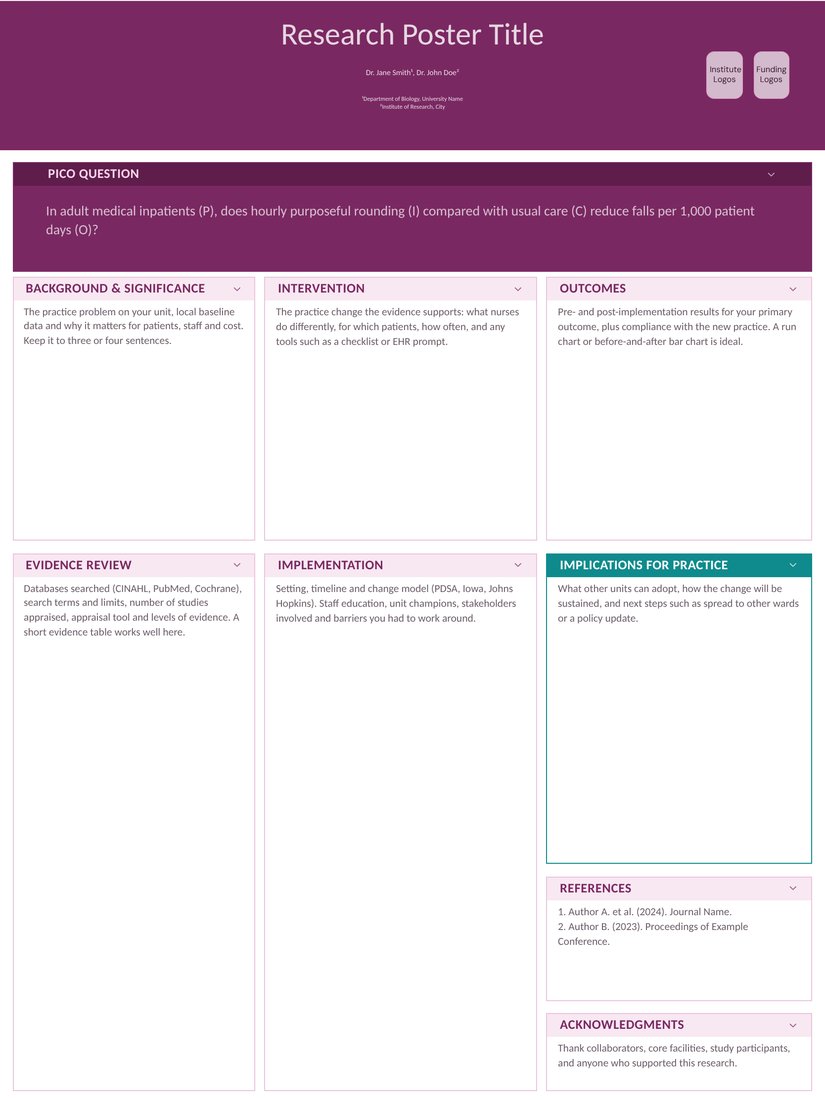
Nursing Practice (Free)
Free. Opens with the PICO question on a full-width banner, then three columns: background and evidence review, intervention and implementation, and outcomes with implications for practice.
-

Modern Infographic (Free)
Free. A narrow intro column, a wide central results column and a summary column; good for QI projects led by one or two numbers, such as falls per 1,000 patient days.
-
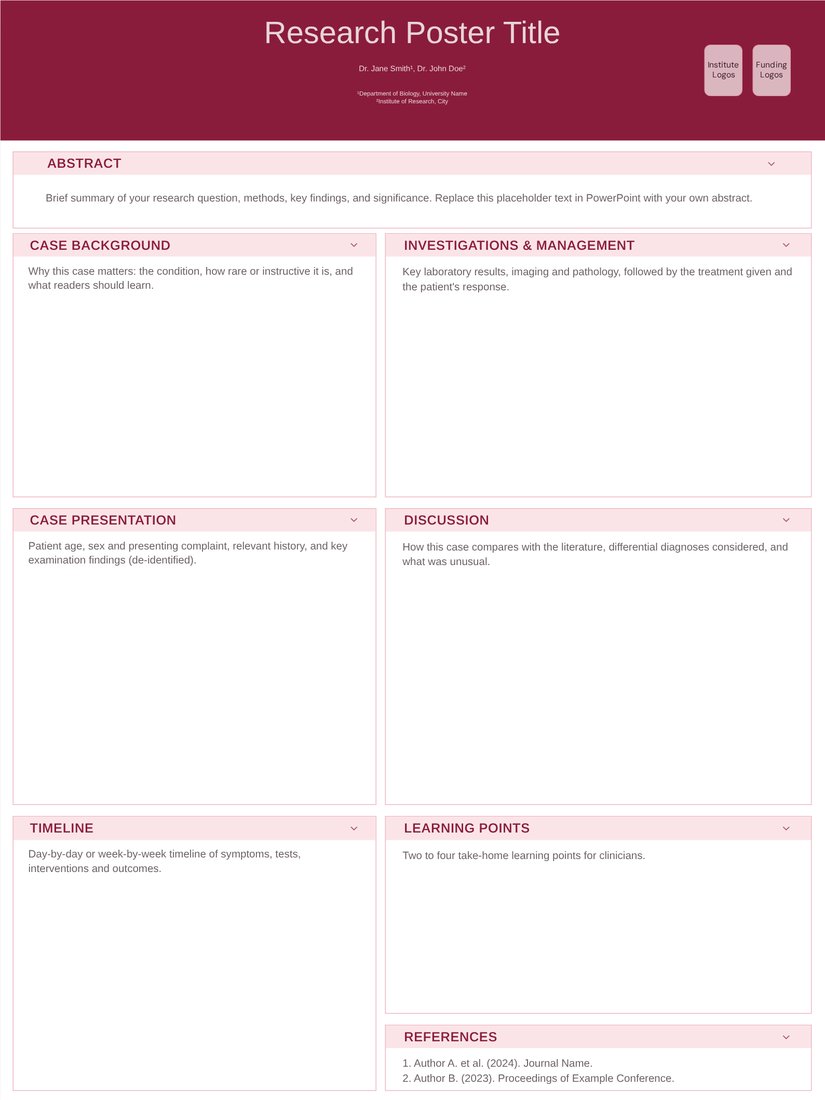
Case Report (Free)
Free. For a patient case study: rename Investigations & Management to Assessment and Nursing Interventions; the timeline and learning points work as they are.
-
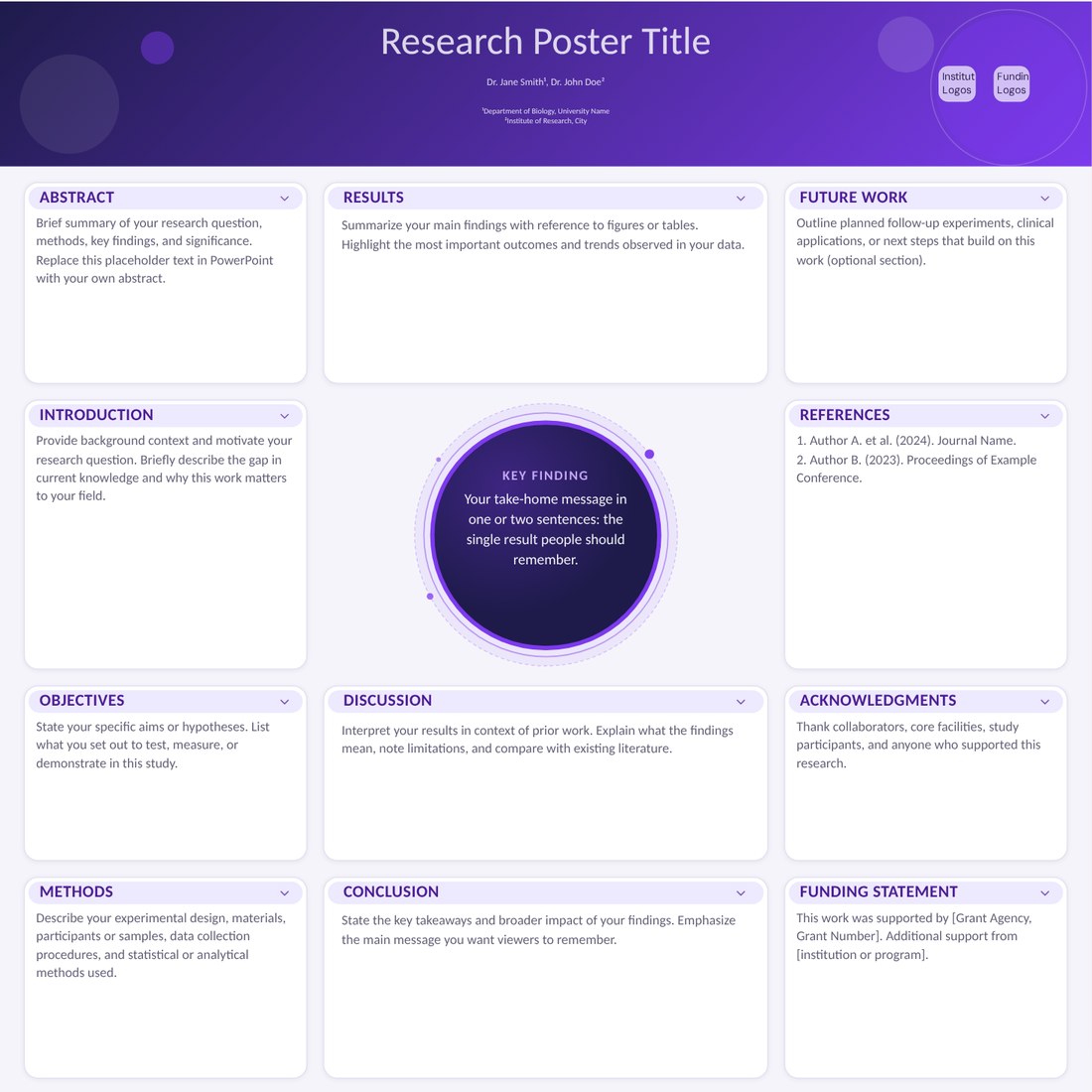
Orbit (Pro)
Pro. One practice change in a central circle with rounded cards around it, useful for a unit-wide EBP project with several linked outcomes.
Writing the PICO(T) question
EBP posters start from a focused clinical question. PICO(T) breaks it into Population, Intervention (or issue of interest), Comparison, Outcome and, optionally, Time. Put the question in the first section as one sentence and label each element so judges can find it at a glance.
- P: adult medical-surgical inpatients at risk of falls
- I: hourly purposeful rounding
- C: usual care
- O: falls per 1,000 patient days
- T: over six months
Showing levels of evidence
Judges expect to see how strong the evidence is, not just what it says. Summarise the appraised sources in a small table with author and year, design, level of evidence and key finding, and name the hierarchy you used. Common choices are Melnyk and Fineout-Overholt's seven levels (Level I, systematic reviews and meta-analyses of randomised trials, down to Level VII, expert opinion) and the Johns Hopkins model's Levels I to V with quality ratings.
- Keep the table to the five to eight strongest sources and put the full list behind a QR code.
- Add one sentence of synthesis: what most sources agree on and where they disagree.
QI posters: PDSA cycles and run charts
- Aim statement: what will improve, by how much and by when, for example "reduce catheter days on our unit by 20% in six months".
- Baseline data and a simple process map or fishbone diagram of likely causes.
- Each PDSA cycle as one short row: what was tested, what happened, what changed next.
- A run chart of the main measure with each change marked, plus a balancing measure (for example staff time) to show nothing got worse elsewhere.
Implications for nursing practice
This is the section judges and visiting nurses read most closely. Say what should change at the bedside, for whom, and what it takes: training, equipment or documentation changes. Then add sustainability: who owns the change now and how it will be monitored.
What nursing conferences and research days usually ask for
Calls for posters at nursing conferences often ask you to choose a category (research, EBP, QI or innovation) and submit a structured abstract that matches it. Hospital EBP days often judge posters with a rubric covering the clinical question, appraisal of evidence, implementation, outcomes and dissemination, so those words make good section headings.
Board sizes range from tabletop tri-folds at some school events to 48 × 36 in or 36 × 48 in boards at conferences; follow the instructions. Nursing posters conventionally list each author's credentials (for example RN, BSN, MSN) with their role and unit or school.
Nursing students and capstone projects
- Confirm the required sections with your instructor; many courses supply a grading rubric.
- If the project was not implemented, still show the evidence appraisal, then describe the proposed implementation and evaluation plan.
- For DNP projects, state the setting, the framework you used and the outcomes you measured.
Frequently asked questions
What is the best template for a nursing poster?
Nursing Practice for EBP and QI projects, Modern Infographic for posters built around a few key numbers, and Case Report for a single patient case study. All are free PowerPoint downloads.
How do I write a PICO question for a nursing poster?
Name the population, intervention, comparison and outcome (and time, if relevant) in one sentence, for example: in adult inpatients at risk of falls, does hourly rounding compared with usual care reduce falls over six months? Label each element on the poster.
What level of evidence should a nursing EBP poster show?
Show the level of each key source using a recognised hierarchy, such as Melnyk and Fineout-Overholt's Levels I–VII or the Johns Hopkins Levels I–V, and name the hierarchy you used.
What size is a nursing poster?
It depends on the event. 36 × 48 in portrait and 48 × 36 in landscape are common in North America, A0 portrait elsewhere, and some student events use smaller 24 × 36 in posters. Every template opens at any of these sizes.
Should I put credentials after author names?
Yes. Nursing posters conventionally list credentials (for example RN, BSN, MSN) after each name, followed by role and unit or school. Check the conference's formatting rules for the order.