Pharmacy poster templates for residency projects, MUEs and research
Quick answer
What should a pharmacy poster include?
A pharmacy poster states the medication-related problem, the objective, the setting and design, and the patients and drugs involved, using generic names with dose, route and frequency. Results usually report clinical outcomes and, where relevant, pharmacist interventions, prescriber acceptance and cost. It ends with implications for pharmacy practice, plus author disclosures and the IRB approval or exemption status.
Pharmacy posters cover a wide range: residency research projects, medication use evaluations (MUEs), pharmacist-led services, drug information projects, adverse drug reaction case reports and student work. They share a reader who looks first for the drugs, doses and outcomes, so those need to be exact and easy to find.
Start from the free Pharmacy Practice template, the Clinical Trial layout for comparative studies, or Case Report for an adverse drug event. Each downloads as an editable PowerPoint file in one click.
Open the Pharmacy Practice template · Medical poster templates
Free PowerPoint downloads
- Pharmacy Practice, 36 × 48 in portrait (.pptx)
- Pharmacy Practice, 48 × 36 in landscape (.pptx)
- Pharmacy Practice, A0 portrait (.pptx)
Editable .pptx with the slide set to the real poster size. One click, no sign-in.
Templates for pharmacy posters
-
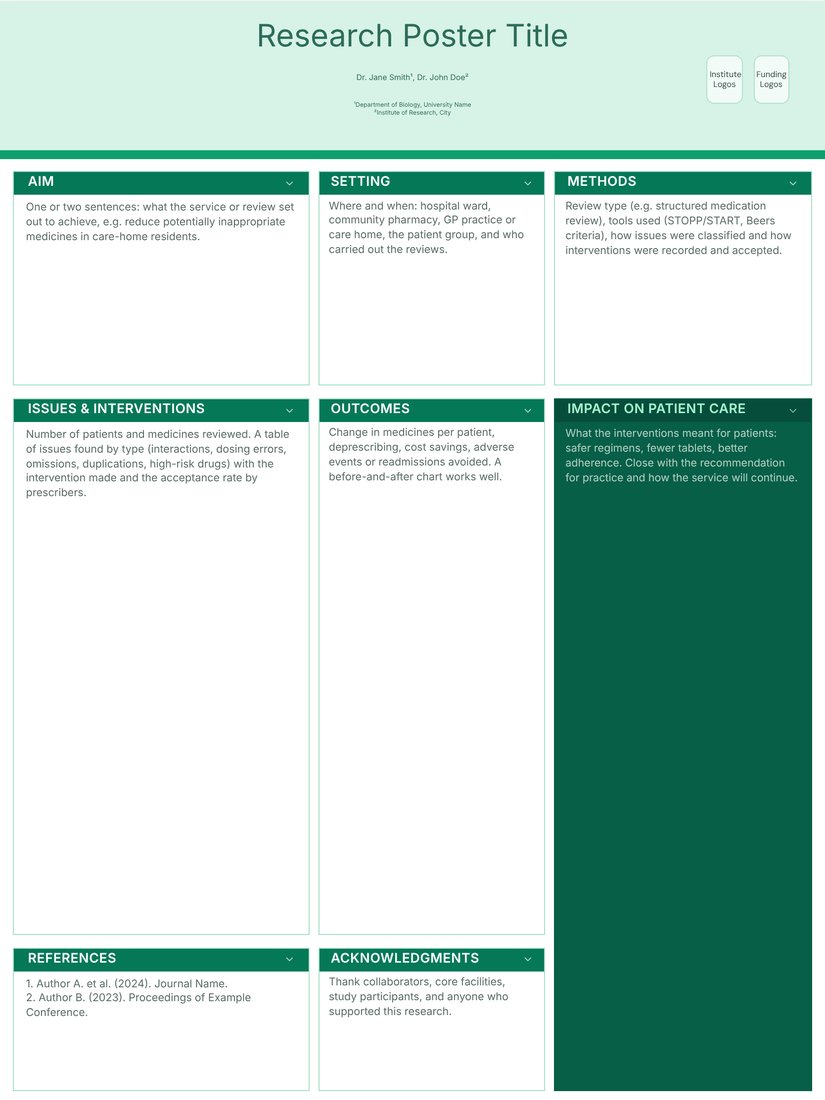
Pharmacy Practice (Free)
Free. Aim, setting and methods in a strip across the top; the widest column holds the medication issues and interventions table, beside outcomes and an Impact on Patient Care box.
-
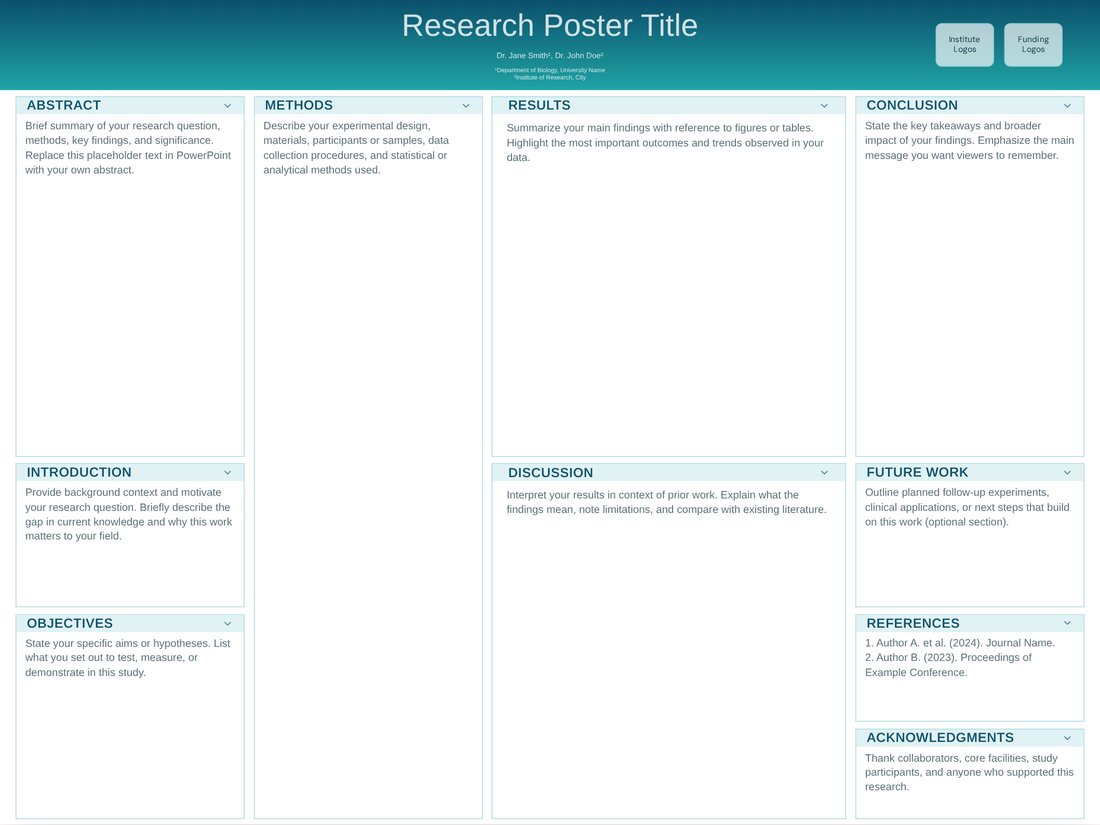
Clinical Trial (Free)
Free. Four landscape columns for a comparative study, such as a before-and-after evaluation of a pharmacist-led protocol; the wide column takes the outcomes table.
-
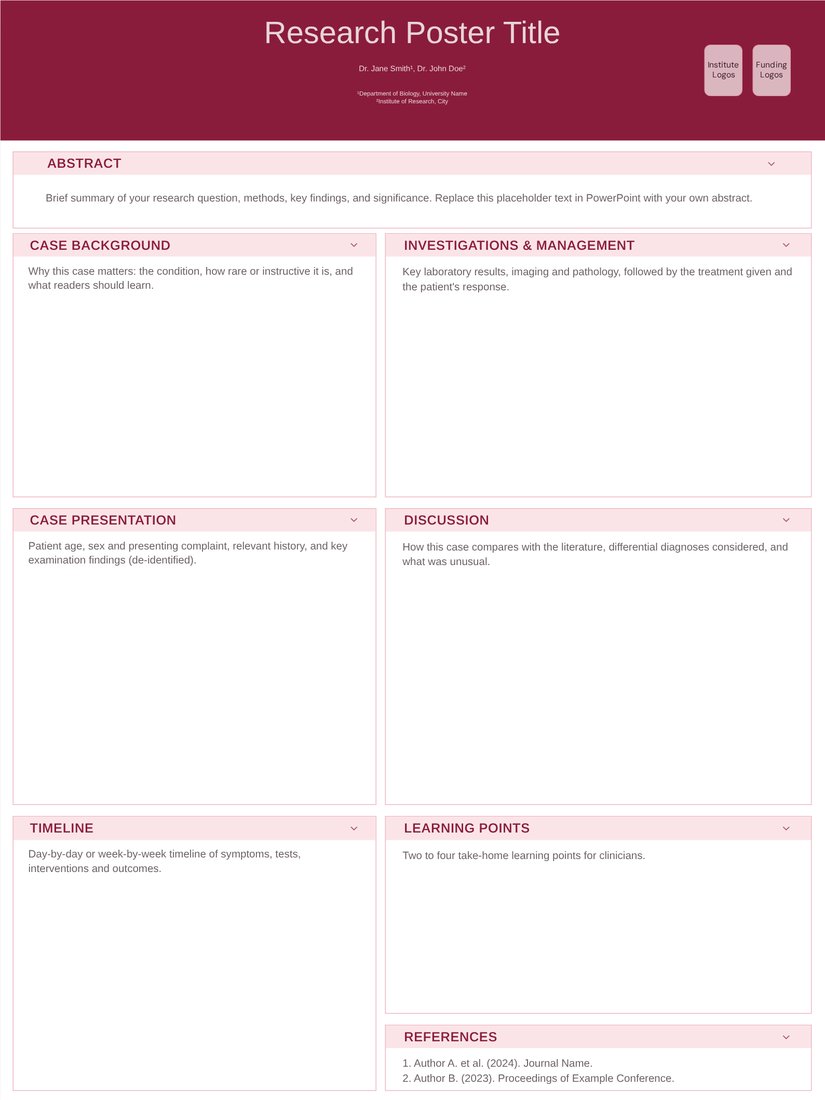
Case Report (Free)
Free. For an adverse drug reaction or interaction case: use the timeline to show drug start, dose changes and stop days against the reaction, the core of a causality assessment.
-
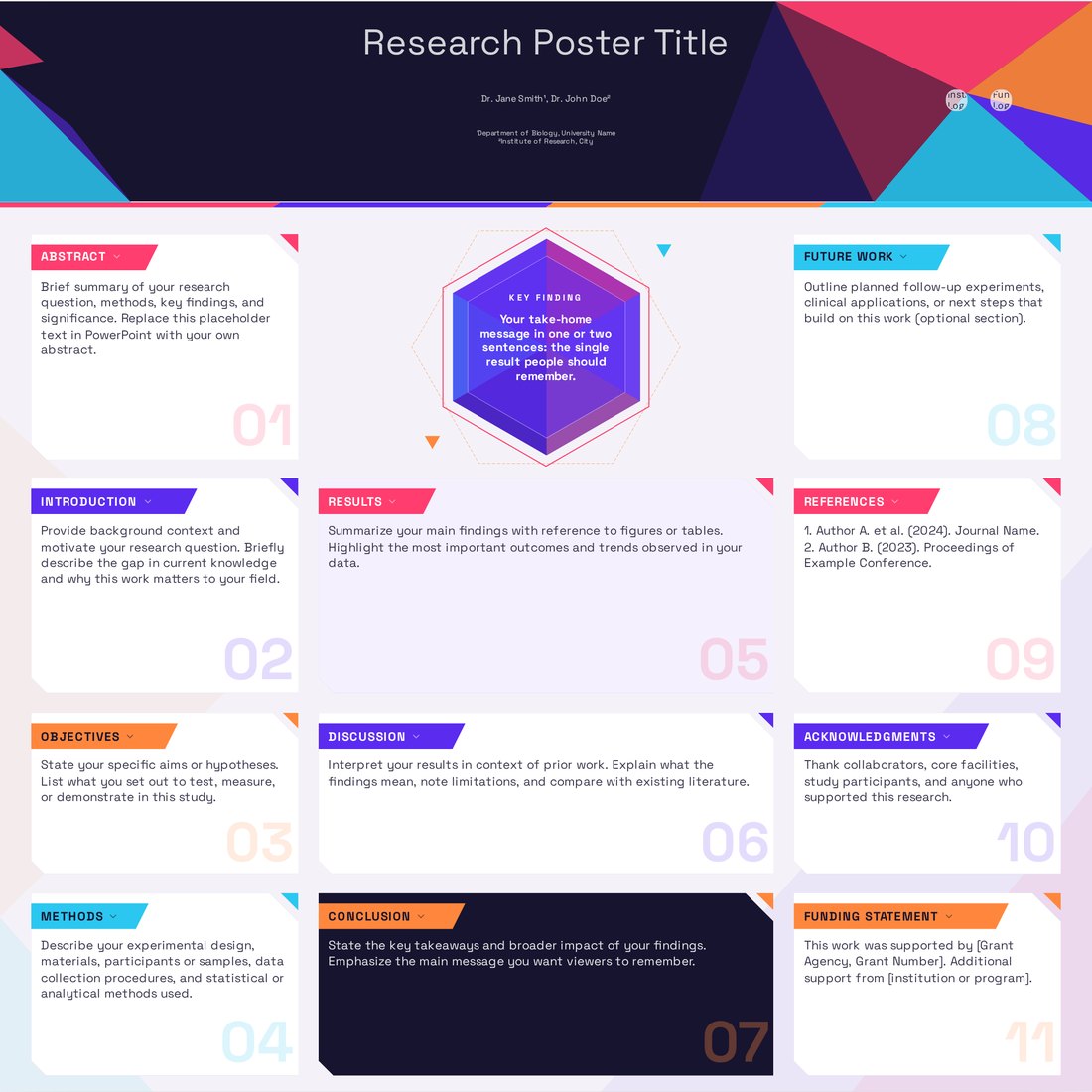
Prism (Pro)
Pro. Cut-corner cards and a hexagon key-finding badge; the hexagon suits one headline number, such as the prescriber acceptance rate.
Common types of pharmacy poster
- Medication use evaluation: criteria for appropriate use, compliance with each criterion and recommendations, run much like an audit.
- Pharmacist-led service or intervention: what pharmacists did, how many interventions were made, how many were accepted, and the clinical or economic result.
- Residency research project: background, objective, methods, results and conclusions, often presented with preliminary results.
- Case report: an adverse drug reaction, interaction or unusual dosing situation, with a causality assessment.
- Drug information or education project: the question, the evidence reviewed and the resource produced.
Writing about medicines precisely
- Use generic (international nonproprietary) names; mention a brand only when the specific product or formulation matters.
- Give dose, route, frequency and duration: "vancomycin 15 mg/kg IV every 12 hours" rather than "vancomycin".
- Avoid error-prone abbreviations such as "U" for units, "QD" and trailing zeros (5.0 mg); ISMP publishes a list of abbreviations to avoid.
- When doses depend on renal function, report it and the equation used, for example Cockcroft-Gault creatinine clearance.
Reporting outcomes
Pharmacy outcomes are often grouped as economic, clinical and humanistic (the ECHO model). Show the ones you measured: clinical outcomes such as time to a therapeutic level or adverse events; economic outcomes such as drug cost or cost avoidance, with the method and source of unit costs; and humanistic outcomes such as patient satisfaction. For intervention studies, report the number and types of interventions and the acceptance rate by prescribers.
Case reports: show causality
For an adverse drug reaction case, the timeline is the evidence. Plot the start, dose changes and stop of each relevant drug against the onset and resolution of the reaction, and note any rechallenge. Name the causality tool and score, such as the Naranjo algorithm, and say whether the event was reported to a pharmacovigilance system.
Tables pharmacists actually read
- A baseline characteristics table limited to variables that affect the result, such as age, renal function and indication.
- An interventions table with categories (dose adjustment, therapy change, discontinuation, monitoring) and counts.
- Keep each table to about six rows on the poster and move the rest to a handout or a QR-linked supplement.
What pharmacy meetings usually ask for
Pharmacy meetings commonly require a structured abstract (objective, methods, results, conclusion), a statement of IRB approval or exemption, and a disclosure of relevant financial relationships for every author, often as a condition of continuing education accreditation. Resident and student sessions may have their own categories and deadlines, and some meetings ask for encore presentations to be labelled. Landscape inch sizes such as 48 × 36 in are common at North American meetings, but confirm the board size before printing.
Frequently asked questions
What is the best template for a pharmacy residency poster?
Pharmacy Practice for most projects, or Clinical Trial if you are comparing two periods or groups in landscape. Both are free PowerPoint downloads at 48 × 36 in, 36 × 48 in, A0 and the other listed sizes.
How do I present a medication use evaluation on a poster?
Treat it like an audit: list the criteria for appropriate use and their source, show compliance with each criterion as n/N and a percentage, then give the recommendations and any follow-up evaluation.
Should I use brand or generic drug names on a pharmacy poster?
Use generic names throughout. Add a brand name only where the specific product or formulation matters to the result.
Do pharmacy posters need a disclosure statement?
Most pharmacy meetings ask for a disclosure of relevant financial relationships for each author. Put it in small type near the references or acknowledgements, using the wording the meeting provides.
How do I show cost savings on a poster?
State what was counted (drug acquisition cost, avoided adverse events, length of stay), where the unit costs came from and the time period. Present cost avoidance as an estimate and explain the method in one line.