Medical poster templates for case reports, trials and audits
Quick answer
What should a medical poster include?
It depends on the study type. A case report follows the CARE order: background, case presentation, timeline, investigations, management, discussion and learning points. A trial or cohort study uses introduction, methods with a participant flow diagram, results with effect sizes and conclusions. An audit shows the standard, compliance and the action plan. All need de-identified images and any required disclosures.
Medical posters are read by busy clinicians between sessions, so the structure has to feel familiar at a glance. That structure depends on the kind of work: a single case, a trial or observational study, an audit or quality improvement project, or a systematic review. Each has a reporting guideline that reviewers recognise, and the right template follows it.
This page matches each kind of medical poster to a free template, explains the conventions behind it and lists what medical meetings usually ask for. Free templates download as an editable PowerPoint file in one click with no sign-in, or open them in the editor to change the size, columns and sections first.
Open the Case Report template · See a finished case report poster
Free PowerPoint downloads
- Case Report, 36 × 48 in portrait (.pptx)
- Case Report, A0 portrait (.pptx)
- Case Report, A1 portrait (.pptx)
- Clinical Trial, 48 × 36 in landscape (.pptx)
- Clinical Trial, A0 landscape (.pptx)
Editable .pptx with the slide set to the real poster size. One click, no sign-in.
Which template and guideline for which medical poster
| Poster type | Template | Reporting guideline | Key figure |
|---|---|---|---|
| Case report or small case series | Case Report | CARE | Timeline of key clinical events |
| Randomised controlled trial | Clinical Trial | CONSORT | Participant flow diagram and primary outcome |
| Cohort, case-control or cross-sectional study | Clinical Trial or Elegant Academic | STROBE | Flow diagram and adjusted estimates |
| Clinical audit | Clinical Audit | Your organisation's audit standards | Compliance per standard, before and after |
| Quality improvement project | Clinical Audit | SQUIRE 2.0 | Run chart across PDSA cycles |
| Systematic review or meta-analysis | Classic Academic | PRISMA | PRISMA flow diagram and forest plot |
Templates for each kind of medical poster
-
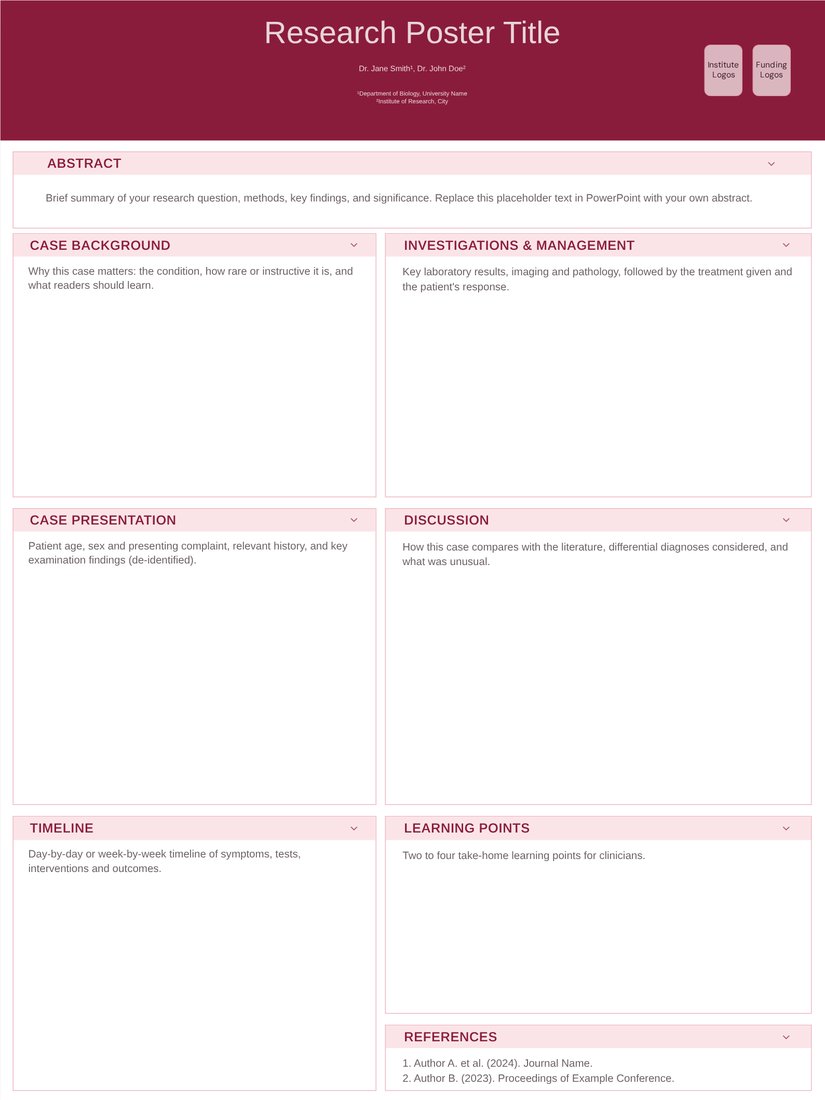
Case Report (Free)
Free. Sections follow a case poster: case background, presentation, timeline, investigations and management, discussion and learning points. Each box has a prompt describing what belongs there.
-
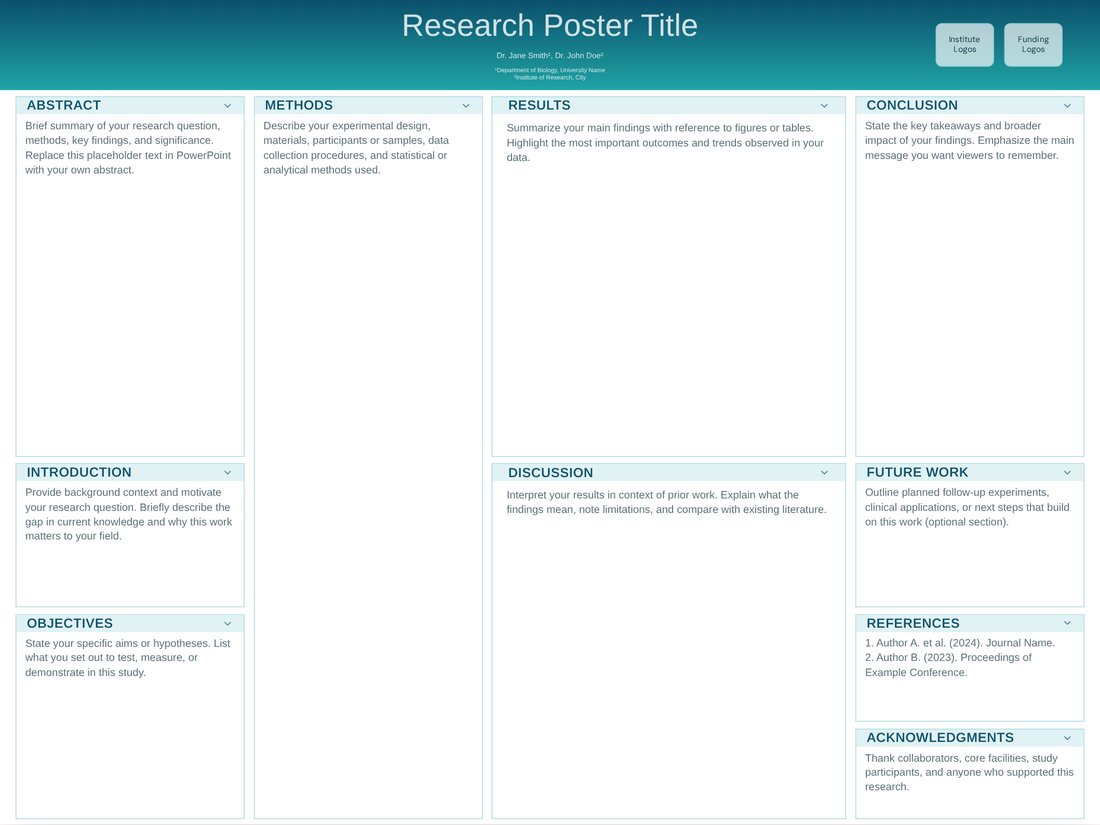
Clinical Trial (Free)
Free. 48 × 36 in landscape with four columns. The tall Methods column fits a CONSORT or STROBE flow diagram, and the widest column holds primary and secondary outcomes.
-
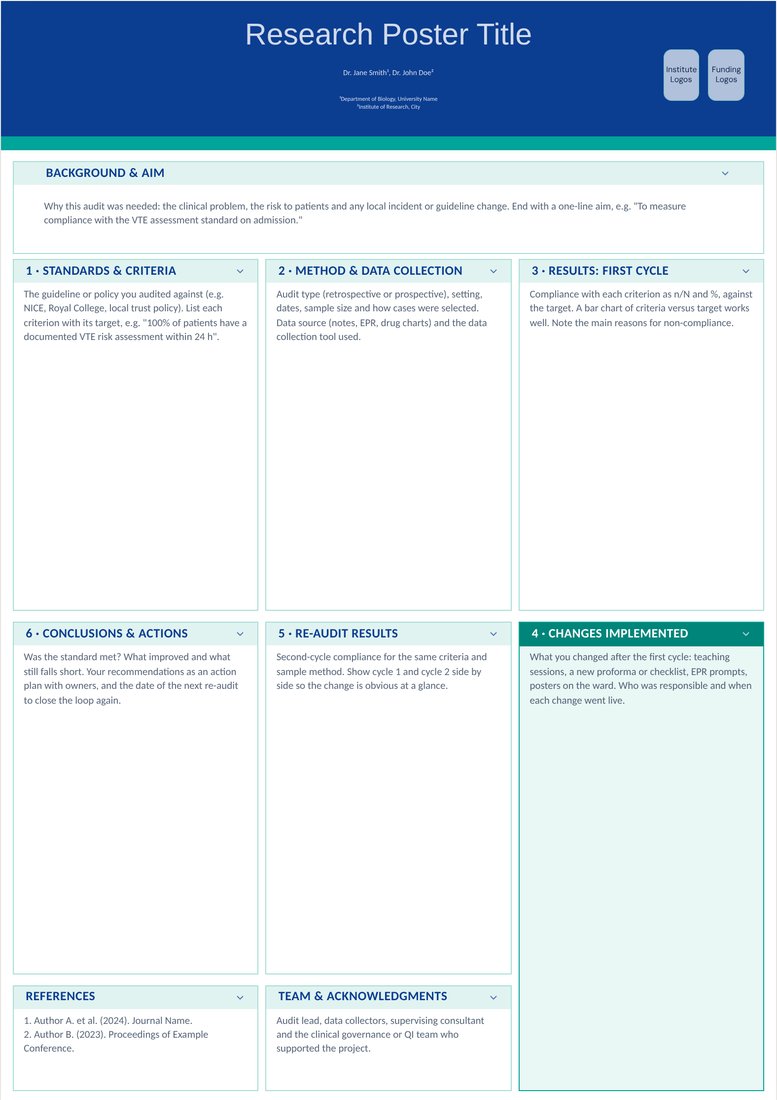
Clinical Audit (Free)
Free. Lays the audit cycle out as a numbered loop: standards, method, first cycle, changes implemented, re-audit and conclusions. The clinical audit page explains how to fill it.
-
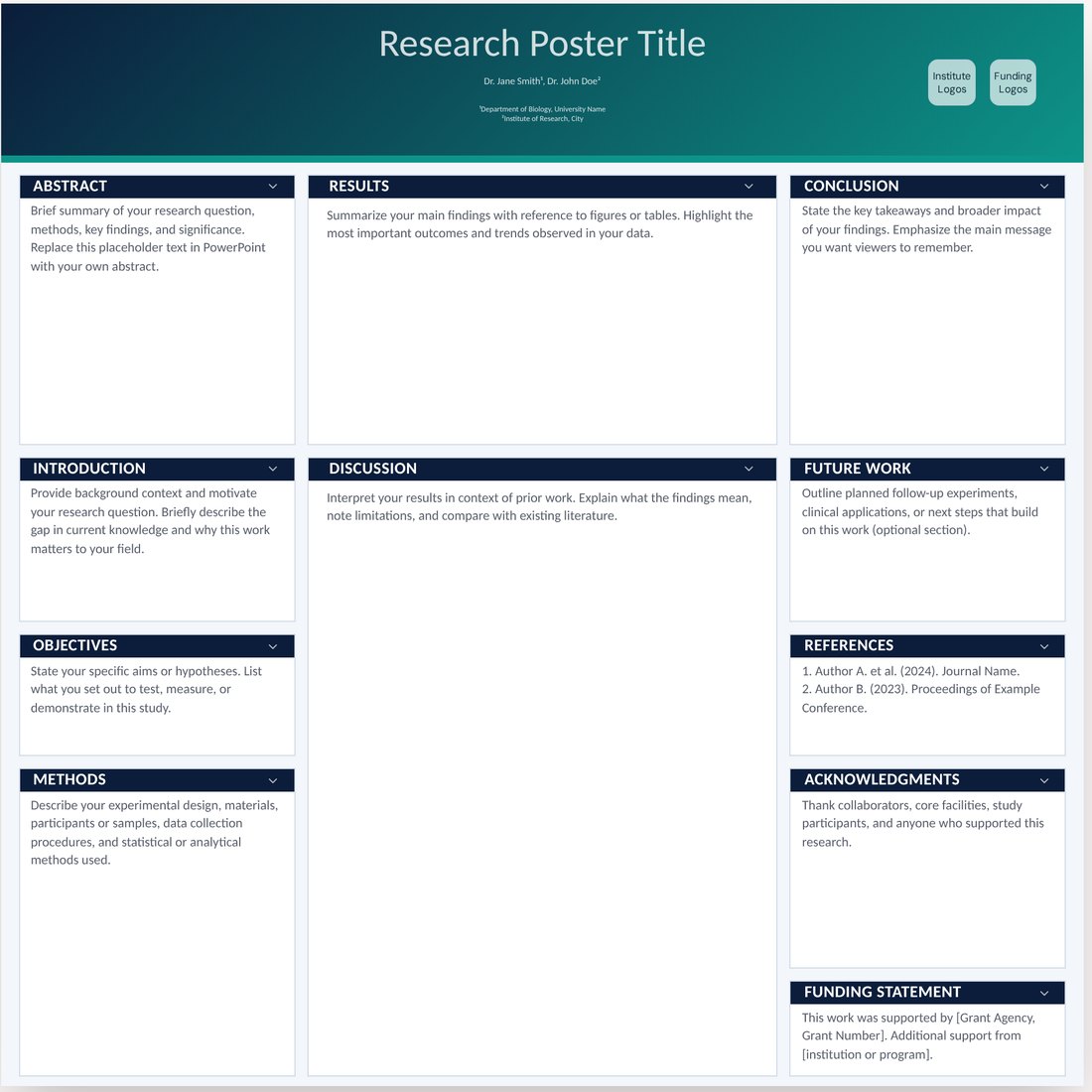
Midnight Aurora (Pro)
Pro. A wide central results column for translational or data-rich clinical studies with several linked figures.
Case reports and the CARE guideline
The CARE guideline (CAse REport) is the standard checklist for case reports, and a good case poster follows its order: why the case matters, de-identified patient information, clinical findings, a timeline, diagnostic assessment including the reasoning and any diagnostic challenges, therapeutic interventions, follow-up and outcomes, and a discussion that ends in a few take-away lessons. CARE also covers the patient's perspective and informed consent.
On a poster the timeline does most of the work. Show it as a sequence of relative days (day 0, day 3, week 6) rather than calendar dates, which can help identify a patient, and number no more than three learning points.
Trials and observational studies
- Put the design in the title or subtitle ("a randomised controlled trial", "a retrospective cohort study") so reviewers know what to expect.
- Write methods as labelled lines: design, setting, participants, intervention or exposure, comparator, primary outcome and analysis.
- Show participant flow with numbers at every step: CONSORT for trials, a STROBE-style diagram for observational studies.
- Lead the results with the primary outcome: effect size, 95% confidence interval and p value, then secondary outcomes and harms.
- Add one line on limitations and, for trials, the registration number (for example a ClinicalTrials.gov or ISRCTN identifier).
Patient confidentiality on posters
- Remove names, initials, hospital numbers, dates of birth and exact dates from text, images and figure labels.
- Crop or mask identifying features in clinical photographs, and check the corners of radiology screenshots, which often carry patient details.
- Obtain written consent where your institution or the meeting requires it, especially for photographs, and state on the poster that consent was obtained.
- A rare condition combined with an age and a place can identify someone without a name, so generalise where you can ("a woman in her 40s").
What medical meetings usually ask for
Instructions vary, so read the acceptance email closely. Most medical congresses specify the board size and orientation (A0 portrait is common at European meetings; North American meetings usually give inches, such as 48 × 36 in landscape), the abstract or poster number to print on the poster, and a disclosure of funding and conflicts of interest.
Many congresses also run e-poster sessions, where the poster is uploaded as a PDF or image and shown on a screen, often in landscape. Check whether you need a printed poster, an e-poster or both before you choose a size.
Posters for medical students and residents
- Agree the authorship order and your supervisor's sign-off before you start designing.
- Ask your hospital or university communications team for logo files instead of copying logos from a website.
- Case reports and audits are common first posters, and both fit comfortably on 36 × 48 in or A0 portrait.
- Prepare a one-minute summary for judges: the case or question, what you found and the one learning point.
Writing for clinicians
- Use generic drug names with dose, route and frequency.
- Define every abbreviation at first use, even common ones; specialties use the same letters for different things.
- Keep units consistent (mmol/L or mg/dL, not both) and match them to the meeting's audience.
- Give absolute numbers alongside percentages (18/120, 15%) so readers can judge small samples.
Frequently asked questions
Which template is best for a medical case report poster?
Case Report. Its sections follow the usual case-poster order (background, presentation, timeline, investigations and management, discussion, learning points), and it is a free PowerPoint download at 36 × 48 in, A0 and every other listed size.
Do I need patient consent for a case report poster?
Requirements depend on your institution and the meeting. Many require written consent for identifiable information or images, and it is good practice to obtain consent and de-identify the case either way. Check your hospital's policy before you submit.
What size should a medical poster be?
Use the size in the meeting's instructions. A0 portrait (841 × 1189 mm) is common in Europe; 48 × 36 in landscape and 36 × 48 in portrait are common in North America. Every template opens at any of these sizes.
How do I fit a CONSORT diagram on a poster?
Use a tall methods column, as in the Clinical Trial template, keep the boxes to the numbers assessed, randomised, allocated, followed up and analysed, and set the diagram text no smaller than your captions.
Can I edit the medical templates in PowerPoint?
Yes. Free templates download as native .pptx files with editable text boxes at the real poster size, no sign-in needed. You can also open them in the free editor to change columns and sections first; exporting from the editor needs a free account.