Clinical audit poster template: present the audit cycle clearly
Quick answer
What should a clinical audit poster include?
A clinical audit poster shows the standard you audited against and its source (usually a national or local guideline), the target, how and when data were collected, compliance in the first cycle, the changes you made and compliance at re-audit. It ends with what still needs to change and who is responsible. A before-and-after chart for each standard is the key figure.
An audit poster answers one question: does practice meet an agreed standard, and did it improve after a change? Reviewers judge it on whether the loop was closed. A clear standard, honest numbers for both cycles and a concrete action plan count for more than decoration.
Use the Clinical Audit template for a two-cycle audit or a quality improvement project, or the landscape Clinical Trial layout when you need room for a process map. Both download free as PowerPoint files.
Open the Clinical Audit template · Medical poster templates
Free PowerPoint downloads
- Clinical Audit, A0 portrait (.pptx)
- Clinical Audit, 48 × 36 in landscape (.pptx)
- Clinical Audit, 36 × 48 in portrait (.pptx)
- Clinical Audit, A1 portrait (.pptx)
Editable .pptx with the slide set to the real poster size. One click, no sign-in.
Audit, quality improvement or research?
| Clinical audit | Quality improvement | Research | |
|---|---|---|---|
| Question | Are we meeting the standard? | How can we make this process better? | What is the answer to a new question? |
| Starting point | An existing evidence-based standard | A problem in a local process | A gap in knowledge |
| Typical method | Measure, compare, change, re-audit | Repeated PDSA cycles | A protocol with a predefined analysis |
| Key figure | Compliance per standard, cycle 1 vs cycle 2 | Run chart or control chart over time | Primary outcome with effect size |
| Reporting | Local audit report format | SQUIRE 2.0 | CONSORT, STROBE or another design-specific guideline |
| Approval | Usually local audit registration; check policy | Usually local QI registration; check policy | Research ethics committee or IRB approval |
Templates for audit and QI posters
-
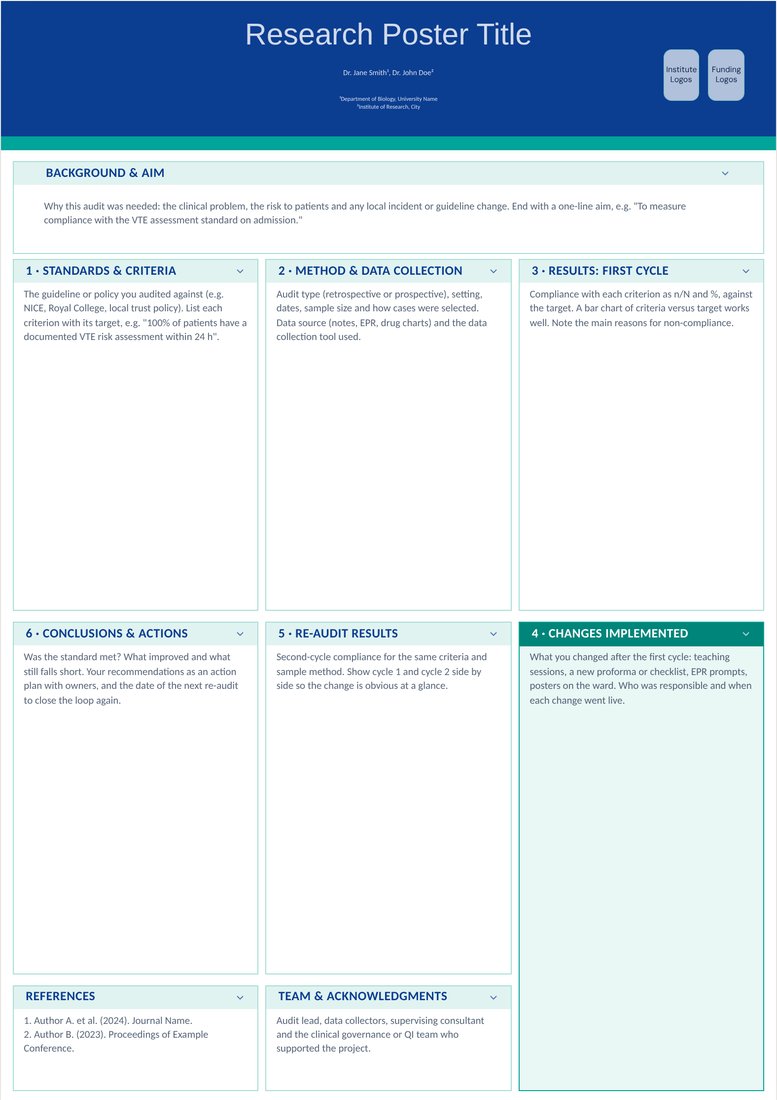
Clinical Audit (Free)
Free. Background and aim across the top, then six numbered boxes that run as one loop: standards, method, first-cycle results, changes implemented, re-audit results, and conclusions and actions.
-
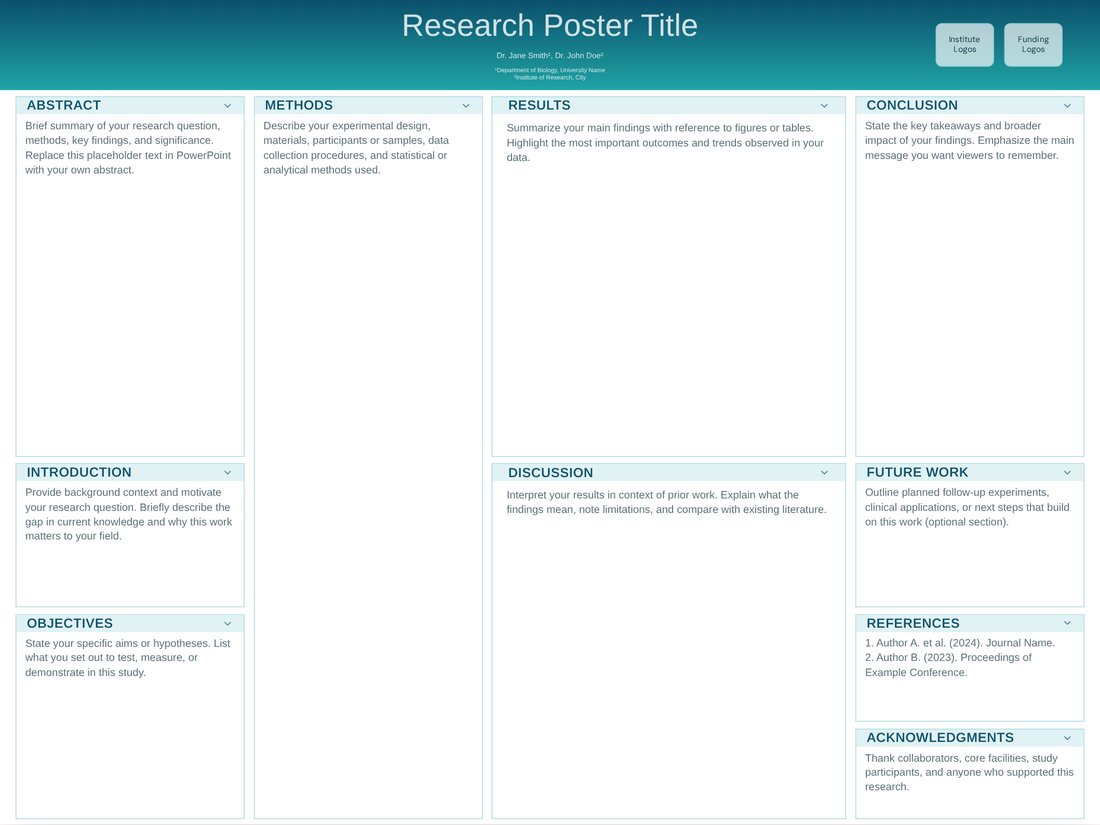
Clinical Trial (Free)
Free. 48 × 36 in landscape with four columns: use the tall Methods column for a process map or data collection flow and the wide column for the before-and-after compliance chart.
-
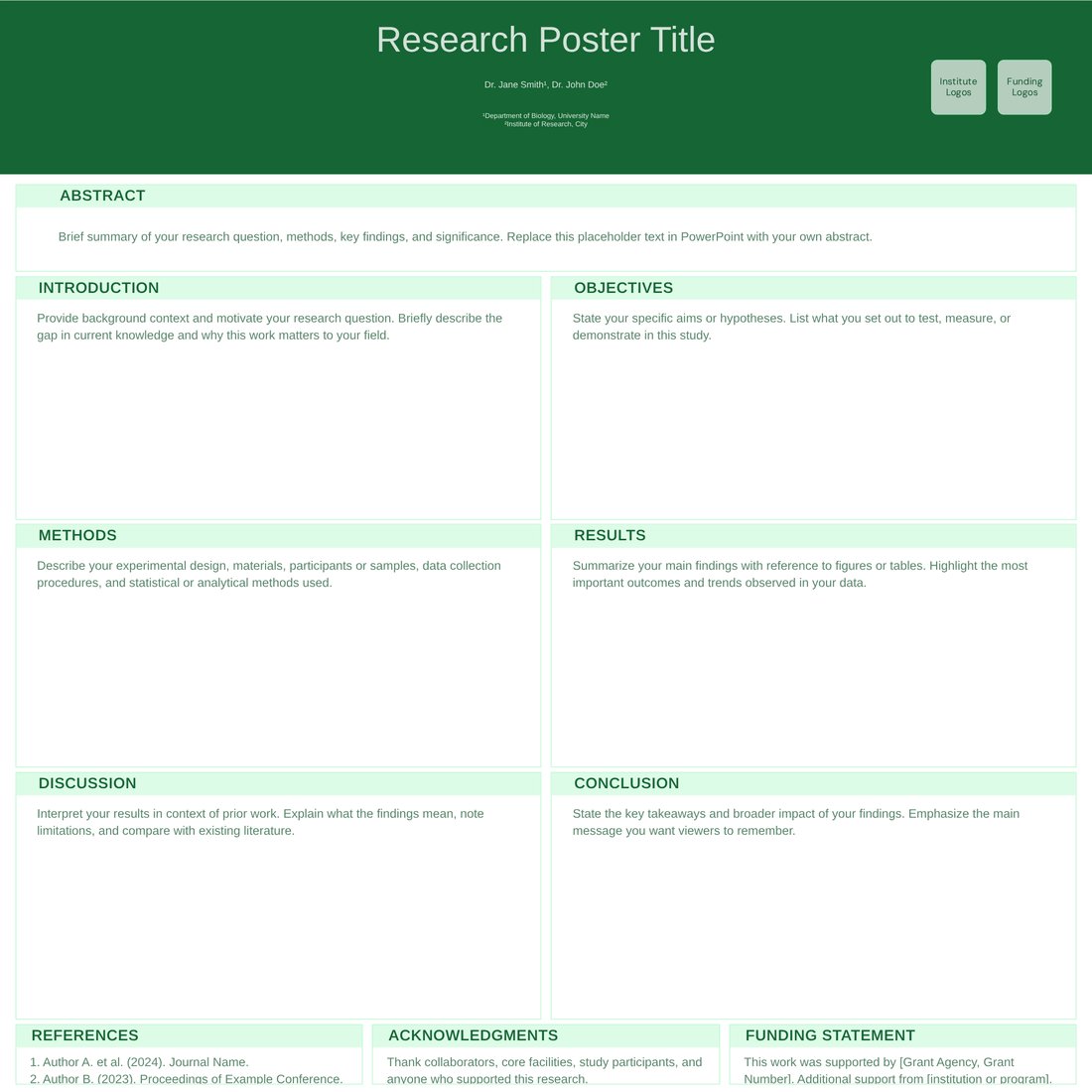
Public Health (Free)
Free. Square 42 × 42 in with six equal panels, which suits a service evaluation where each panel covers one standard or measure.
-

Atelier (Pro)
Pro. A large circular key-finding hub for the headline change in compliance, with the audit details in the cards around it.
The audit cycle on one poster
- Topic: why this was audited, for example a safety incident, a new guideline, wide variation in practice, or a high-volume or high-cost process.
- Standard: the criterion, the target and the source, for example "All patients admitted with X should receive Y within Z hours (target 95%; national guideline, year)".
- Measurement: the sample, time period, data source (case notes, electronic record or a prospective form) and any exclusions.
- First cycle: compliance with each standard as numbers and a percentage (41/60, 68%).
- Changes made: the interventions, such as teaching sessions, a revised proforma, ward reminders or a change to an order set.
- Re-audit: the same standards measured the same way after the change.
- Action plan: what happens next, who owns it and when the next cycle is due.
Writing good standards
A standard has three parts: a criterion that can be answered yes or no for each patient, a target percentage and an evidence source. A target of 100% is reasonable for safety-critical steps; for others, set a realistic target and state accepted exceptions, such as patients who declined or had a documented contraindication. Quote the guideline and its year so readers can judge whether the standard is current.
Showing the results
- Use one grouped bar chart: each standard on the x axis, cycle 1 and cycle 2 side by side, and a dashed line at the target.
- Label bars with n/N as well as the percentage, because small samples make percentages jump.
- If you measured repeatedly over time, use a run chart with the change points marked instead of two bars.
- Use colour to separate the cycles, not to mean good and bad; red and green alone exclude colour-blind readers.
Closing the loop
Judges at audit and QI sessions commonly look for evidence that the loop was closed with a re-audit after the change. If you only have the first cycle, say so, present the action plan and give the date of the planned re-audit. A one-cycle audit with a clear plan is still a useful poster, especially for students and junior doctors.
What audit and QI sessions usually ask for
Hospital audit days, trainee meetings and specialty congresses often run separate audit or quality improvement categories. Abstracts are usually structured as background, standards, method, results for both cycles, and conclusions or actions. Check whether the meeting wants your audit registration number from the organisation's audit or quality team, and use the board size and orientation it specifies.
Approval and data protection
In many health systems, audits and service evaluations are registered with the local audit or quality improvement team rather than a research ethics committee, but the rules differ between countries and institutions, so check before you collect data. Present aggregated numbers only, and never show patient identifiers, details that could identify individuals in a small unit, or staff names.
Frequently asked questions
What is the difference between a clinical audit and research?
An audit measures current practice against an existing standard to see whether it is met; research generates new knowledge, such as whether a treatment works. An audit poster therefore leads with the standard and compliance, not a hypothesis.
What chart should I use on an audit poster?
A grouped bar chart with each standard on the x axis, the first and second cycle side by side and a line at the target. Use a run chart instead if you measured repeatedly over time.
Can I present an audit with only one cycle?
Yes, but say so. Show the first cycle, the changes you have introduced and the date of the planned re-audit. Many judges score closed-loop audits higher, so mention when the second cycle will be done.
What size should an audit poster be?
Use the size in the meeting instructions. A0 portrait is common at European meetings and 48 × 36 in landscape at North American ones. Templates open at either size, and the PowerPoint download is free.
Is the Clinical Audit template free?
Yes. It downloads as an editable PowerPoint file with no sign-in, and you can open it in the free editor to change the size, columns or section titles before exporting.